Criteria for Selection
Selection begins with safety thresholds drawn from early childhood protocols. Materials must exceed the standard small parts cylinder dimensions of 1.25 inches in diameter and 2.25 inches deep to prevent choking hazards for children under three.
Open-ended items receive priority because they support multiple imaginative functions without prescribed outcomes. The process also limits supplementary supplies to no more than 2 to 3 items such as masking tape or washable markers so the household object remains the central focus.
1. Cardboard Box Creations
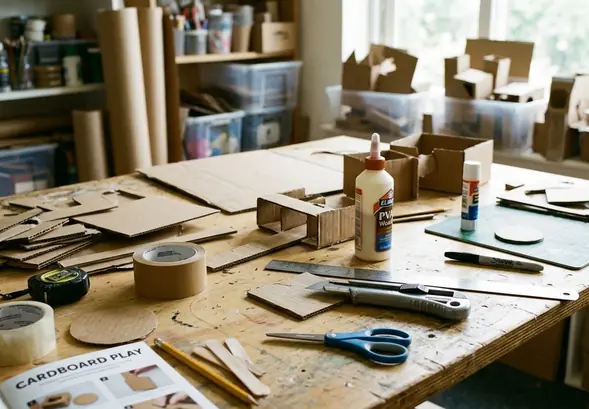
Standard single-wall corrugated cardboard, typically 1/16 to 3/32 inches thick, requires heavy-duty shears or pre-scoring rather than standard children's craft scissors. Pre-scored folding techniques replaced earlier plans that relied on utility knives, keeping children actively involved in the assembly sequence.
Collaborative building with large appliance boxes typically sustains a toddler's attention for 15 to 25 minutes per session. Spatial reasoning develops as children negotiate openings for doors and windows while testing how weight distribution affects stability.
2. Paper Towel Roll Sculptures
Adhesive methods were evaluated against mechanical connections. The slit-and-slot approach proved more reusable. Cutting 4 to 6 vertical slits measuring 0.5 to 0.75 inches deep at the ends of the cardboard tubes allows them to interlock securely without tape.
Structures built with 8 to 12 interlocking tubes can support their own weight up to a height of 24 to 30 inches before requiring a wider base. Balance exploration occurs naturally when children add cross-bracing or adjust tube angles to prevent tipping.
3. Plastic Bottle Planters
Radish or bush bean seeds typically germinate in 4 to 7 days when maintained at standard indoor temperatures of 68 to 72 degrees Fahrenheit, based on our growing trials. A standard 16-ounce plastic bottle requires 3 to 4 drainage punctures at the base to prevent waterlogging the root system.
Transparent bottles expose soil and roots to direct sunlight, which can promote rapid algae growth if placed in a south-facing window. Responsibility develops through daily observation of moisture levels and adjustment of placement to manage light exposure.
4. Sock Puppet Storytelling
Standard liquid fabric glue requires 2 to 4 hours of curing time before the puppet can withstand active play. Low-temperature hot glue sets and cools completely in 45 to 60 seconds, allowing for almost immediate use in storytelling sessions.
Old socks receive fabric scraps and buttons attached by an adult using the faster adhesive. Narrative and language skills advance as children assign voices and plot turns to the finished characters during improvised scenes.
Extending Play Beyond the Projects
Child-led adaptations appear when materials remain accessible after the initial construction phase. Rotating out 3 to 5 specific craft materials every 10 to 14 days maintains higher levels of independent play.
Introducing a single new household item, like a whisk or a textured fabric scrap, can extend an existing play schema by 10 to 15 minutes. Daily routines gain connection when puppets retell events from the morning or planters move to a windowsill already used for other observations.
Cardboard structures collapsing prematurely when constructed with standard school glue instead of interlocking joints or low-tack masking tape illustrates the value of matching connection methods to material properties. The lifespan of a plastic bottle planter depends heavily on the drainage provided; without a 0.25-inch gravel layer or adequate bottom punctures, root rot sets in rapidly.