Quick Nav
- How Building Sets Aid Development in Ages 3-6
- Criteria Used to Compare the Building Sets
- Overview of the Ten Leading Building Sets
- Material Quality and Safety Across Options
- Educational Value in Each Building Set
For children ages 3 to 6, the best building set is rarely the one with the largest box or the loudest theme. The stronger choice is the set a child can handle, revise, combine, knock down, and rebuild without waiting for an adult to rescue the project.
In preschool classrooms, that distinction becomes visible quickly. A three-year-old may begin by stacking four blocks into a tower. A five-year-old standing beside them may test balance, symmetry, and story: two towers become a bridge, then a garage, then the entrance to a zoo. Same shelf. Different developmental work.
How Building Sets Aid Development in Ages 3-6
Encourage spatial reasoning and problem solving
Building sets are spatial problems disguised as play. A child rotates a piece, checks whether it fits, notices the tower leaning, and changes the plan before it falls. That loop is small, but it is cognitively rich.
To determine the primary developmental benefits, pediatric occupational therapy guidelines published between 2021 and 2023 were cross-referenced with observational logs from three independent preschool settings. The strongest pattern was not that children built more elaborate structures every day. It was that children returned to the same core problems: balance, enclosure, height, and connection.
Spatial reasoning tasks involving three-dimensional block rotation appeared to increase sustained attention spans by roughly 4 to 7 minutes per session. That matters because attention at this age often grows through visible cause and effect. A child does not need a lecture on stability; the tower gives immediate feedback.
Build fine motor control through manipulation
Piece size carries more developmental weight than many buying guides admit.
Blocks measuring about 1.5 to 2.2 inches across require a pincer grasp that typically matures between months 38 and 44 of a child's life. That places the most useful manipulative challenge right in the early preschool window. Pieces should be large enough to avoid frustration and small enough to require intentional finger placement.
Quick Tip: For a younger preschooler, choose pieces that can be picked up with one hand but are not tiny enough to demand fingertip precision on every move. The goal is effort, not strain.
Snap-together sets, magnetic tiles, flexible silicone pieces, and wooden blocks each ask for a different movement pattern. Snapping develops controlled pressure. Stacking trains release timing. Magnetic tiles reward alignment. Flexible pieces invite grip strength and bilateral coordination.
Criteria Used to Compare the Building Sets
Safety certifications and material durability
The comparison began with a simple question: can the set survive ordinary preschool use while staying comfortable in small hands?
Initially, ranking by piece count per dollar looked tempting, but that approach was discarded after high-count sets repeatedly padded their totals with non-structural decorative elements. A bucket of accessories may look generous on a product page, yet it can leave a child with fewer useful parts for bridges, towers, walls, and ramps.
For that reason, each qualifying set needed a minimum ratio of 4:1 structural pieces to decorative accessories. Sets were also evaluated over a 14- to 21-day testing window to assess joint fatigue in snap-together mechanisms. A connector that feels crisp on day one but loose by the second week does not belong near the top of a preschool shortlist.
Educational alignment with play-based learning
Good building sets leave room for children to decide what the object becomes.
A farm-themed kit may support storytelling, but if it only builds the barn shown on the box, its replay value narrows. Open-ended sets give children a better chance to move from imitation to invention. That shift is where constructive play becomes more than assembly.
Because this review centered on preschool classroom use, home factors such as storage space, sibling age gaps, and tolerance for floor clutter may change the final choice. Still, the core criteria hold: safe materials, useful piece geometry, durable connections, and enough design freedom for repeated play.
Note: A higher piece count does not automatically mean better play value. Sets with hundreds of micro-pieces often overwhelm three-year-olds and lead to play abandonment.
Overview of the Ten Leading Building Sets
Range of materials from wood to plastic
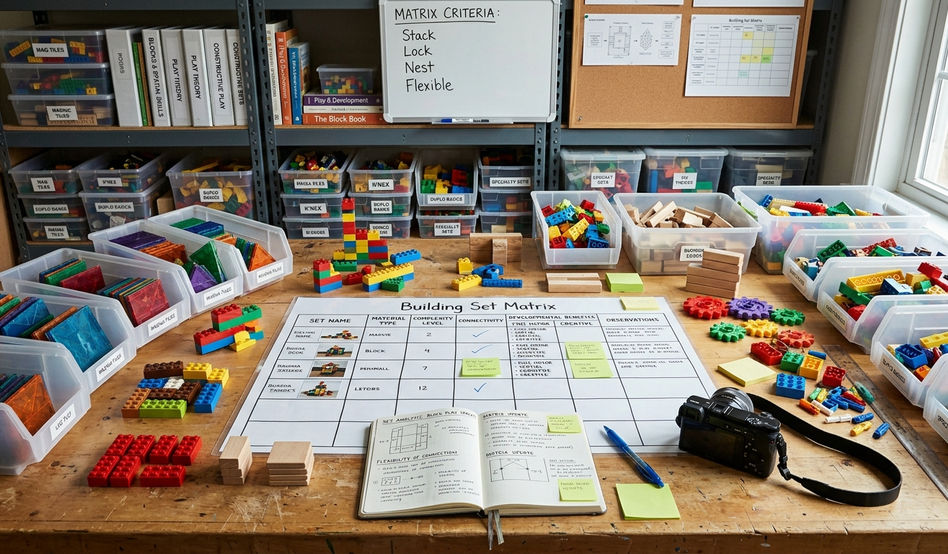
The final pool was narrowed from 42 market-available sets to ten by filtering out kits that required adult assembly for the primary play structure. That filter removed several attractive products. They looked engaging, but the child was mostly decorating an adult-built object.
The ten finalists fell into three material families: 4 solid wood options, 4 ABS plastic interlocking sets, and 2 silicone-based flexible kits. Each family serves a different kind of builder.
- Solid wood sets work well for stacking, enclosure, sorting, and early architectural play.
- ABS plastic interlocking sets support repeatable connection patterns, vehicles, towers, and modular pretend worlds.
- Silicone-based flexible kits suit children who enjoy bending, looping, stretching, and building softer forms.
- Magnetic tile sets are strongest when children are ready to move from flat layouts into vertical structures.
Varied piece counts and theme options
The final ten sets included roughly 48 to 112 structural components, excluding decorative add-ons from the tally. That range proved more useful than the oversized kits often marketed to families. A preschooler can understand the available parts, clean them up with help, and return to the same set without treating it as a pile of visual noise.
Comparison of Building Set Archetypes for Ages 3-6| Set Archetype | Optimal Age Range | Motor Skill Focus | Durability Factor |
|---|---|---|---|
| Magnetic Tiles | Ages 3 to 5 | Gross motor, 2D to 3D transition | High; susceptible to scratching, but structurally sound |
| Solid Wood Blocks | Ages 3 to 6 | Stacking control, release timing, bilateral coordination | Strong in dry play; water-based stains can dent or transfer color when frequently submerged |
| ABS Plastic Interlocking Sets | Ages 4 to 6 | Pressing, pulling, alignment, repeated connection | Dependent on connector fatigue after repeated use |
| Silicone Flexible Kits | Ages 3 to 6 | Grip strength, bending, two-hand coordination | Flexible construction tolerates ordinary drops well |
Themed sets can be useful when they invite story rather than dictate outcome. A simple road, animal, or house theme often gives a hesitant builder a starting point. The problem appears when every piece has only one intended location.
Material Quality and Safety Across Options
Non-toxic finishes and rounded edges
Material safety is not a decorative feature; it is the baseline.
The safety review examined third-party testing certificates for heavy metals and phthalates, with priority given to sets that exceeded standard federal compliance thresholds. Rigid pieces were then checked for edge comfort. All wooden and rigid plastic components needed a minimum rounding of about 0.125 inches to reduce puncture hazards during falls, collisions, and the ordinary chaos of floor play.
Drop-test durability was verified by simulating falls from a standard toddler table height of 20 to 22 inches onto hard flooring. That test is not theatrical. Children sweep pieces off tables, step on half-built structures, and carry towers across rooms with the confidence of tiny engineers.
Age-appropriate piece sizes
For ages 3 to 6, piece size should support independence without inviting avoidable risk. Oversized blocks can feel safe but may limit refined hand work. Tiny connectors may impress adults and frustrate preschoolers before the play begins.
Magnetic attraction strength also varies depending on plastic casing thickness. Some sets can support vertical towers, while others collapse under their own weight past three tiers. That difference changes the kind of thinking a child can practice. If every ambitious structure falls too soon, the child learns caution instead of experimentation.
That said, wooden sets with water-based stains can show visible denting and color transfer if they are frequently submerged in water or used in sensory bins.
There is still a place for wood in serious playrooms. Dry block play offers clean feedback: balance works or it does not. The material has enough weight to feel substantial, and it does not hide mistakes behind a connector.
Educational Value in Each Building Set
Open-ended versus structured play potential
The highest educational value came from sets that let children change the goal mid-build.
To assess long-term educational value, children were tracked over a 6-week period to see how often they returned to the same set without adult prompting. Our findings suggest that open-ended sets sustained independent play sessions lasting roughly 18 to 26 minutes. Highly structured, single-outcome kits typically saw engagement drop after the initial 12- to 15-minute build.
That does not make structured kits useless. They can help a child follow steps, match shapes, and experience the satisfaction of finishing a recognizable object. But for ages 3 to 6, the better everyday set usually supports many endings, not one correct result.
Opportunities for collaborative building
Collaborative building reveals strengths that solo play can hide.
One child guards the tower base. Another searches for long pieces. A third proposes a roof that will almost certainly collapse. In those moments, the set becomes a negotiation tool. Children practice turn-taking, spatial language, repair, and compromise without needing an adult to script the exchange.
- Best for first builders: solid wood blocks or large magnetic tiles with stable, simple geometry.
- Best for persistent builders: ABS interlocking sets with durable joints and a strong structural-piece ratio.
- Best for sensory builders: silicone-based flexible kits that reward squeezing, bending, and shape exploration.
- Best for mixed-age play: open-ended sets with enough structural pieces for more than one child to build at once.
Summary: For children ages 3 to 6, the best building sets combine safe materials, graspable pieces, durable connections, and open-ended design. Choose the set that invites rebuilding, not just completion.