From Scattered Parts to Working Ideas
Simon Nicholson’s original loose-parts theory was published in a 1971 issue of Landscape Architecture. Open-ended materials multiply the ways children invent structures and systems. Early engineering happens when children test balance, force, span, and redesign through play. While formal STEM kits serve specific purposes, loose parts offer raw variables.
The following twelve challenges target developmental windows between ages 3 and 10. Each includes a specific skill focus, an age band, and adult-extension moves that protect child agency.
Why Loose Parts Train Early Engineering Thinking
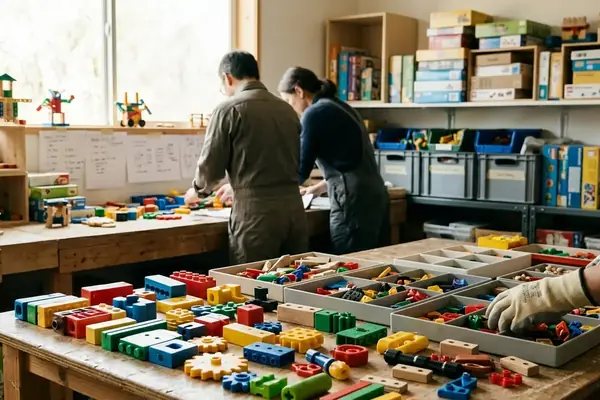
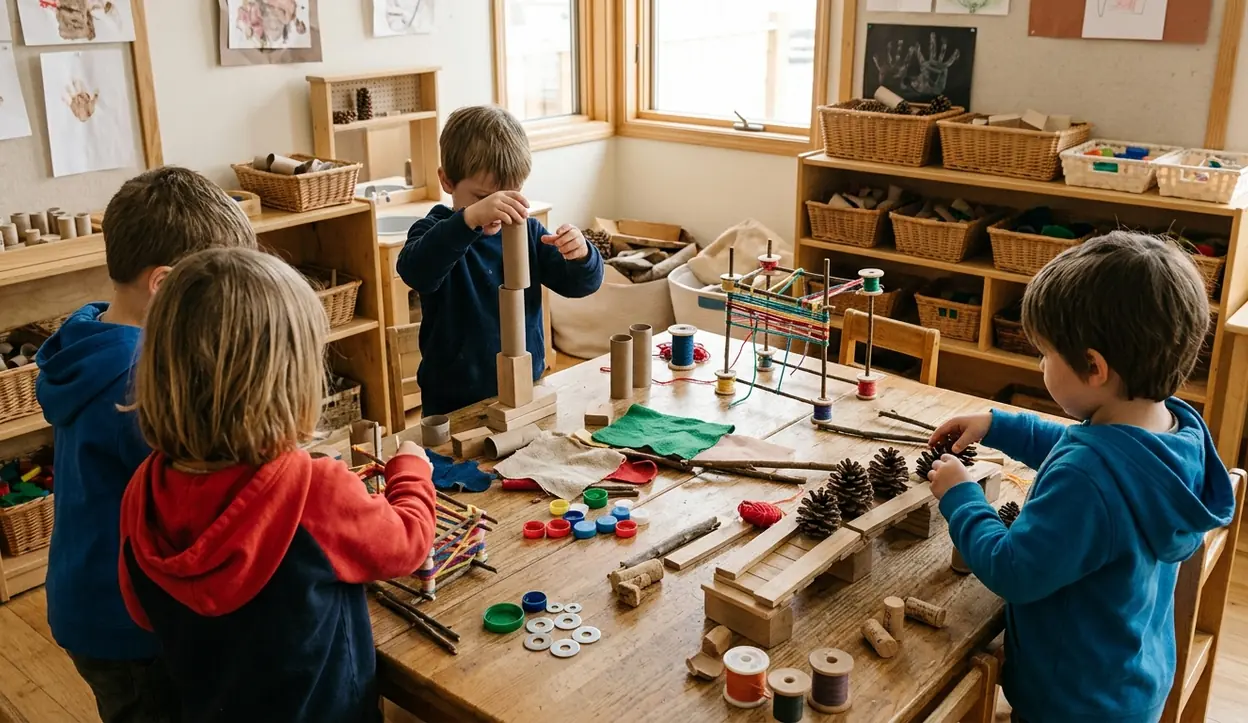
Loose parts include blocks, tubes, cups, connectors, ramps, recycled packaging, sticks, stones, and fabric scraps. These materials map directly to engineering habits. Children hypothesize, prototype, fail, revise, and communicate. Fixed toys dictate a specific outcome. Variable materials invite load paths, joints, and motion systems.
Developmental timelines confirm this trajectory—spatial reasoning and cause-and-effect mapping typically show significant developmental leaps between 36 and 48 months of age.
A Working Loose-Parts Kit for Building Challenges
Building a core kit requires grouping items by function. Initially, educators often try sorting loose parts by strict material type, keeping all wood together and all plastic together. Practitioner accounts indicate this limits cross-pollination. Grouping by function encourages structural thinking.

- Mass: blocks, boxes
- Linear: tubes, sticks, cardboard strips
- Vessels: cups, tins
- Connectors: clothespins, tape, rubber bands, clay
- Motion: balls, marbles, ramps
Natural objects add texture to any of these categories. Safety requires strict choke-size checks. Standard choke-tube testers measure about 1.25 inches in diameter and 2.25 inches deep; any part fitting entirely inside is excluded for children under three. Storage should keep parts visible and reachable so children initiate builds.
Environmental Variables in Play
The effectiveness of tape as a connector varies heavily depending on the humidity of the room and the porosity of the recycled cardboard being used.
Challenges 1–3: Stability, Balance, and Base Design
Challenge 1: The Tap-Test Tower
Build the tallest tower that still stands after a soft tap. The skill focus here is stability and center of mass, optimal for ages 3 to 7. Adults can extend the learning by asking which base shape resists the tap best.
Challenge 2: The Chair Bridge
Construct a bridge between two chairs using only flat and long parts. Setting the chairs 12 to 18 inches apart provides enough span to require structural thought without exceeding the length of standard cardboard strips. This targets span and support for ages 4 to 8. Adults can extend this by introducing a toy car as a test load.
Challenge 3: The Heavy Book Platform
Design a platform that holds a heavy book without collapsing. This isolates load distribution for ages 5 to 9. Adults can extend the challenge by swapping one support and comparing the outcomes.
Challenges 4–6: Force, Ramps, and Controlled Motion
Challenge 4: The Direction-Change Path
Create a marble or ball path with at least two direction changes. Adjusting the ramp angle between 15 and 30 degrees allows children to visibly observe changes in friction and velocity. This focuses on trajectory and friction for ages 4 to 8. Adults can extend by changing the ramp angle only.
Challenge 5: The Resistance Run
Build a cup-and-tube run that slows a rolling object before the end. This highlights energy and resistance for ages 5 to 9. Adults can extend the build with fabric or sandpaper inserts.
Challenge 6: The Target Catapult
Assemble a catapult or lever that launches a soft pom-pom into a target zone. This trains levers and force transfer for ages 5 to 10. Adults can extend by moving the fulcrum position. Using soft projectiles like pom-poms limits the measurable kinetic energy transfer, meaning children won't see the same dramatic trajectory arcs they would with heavier wooden beads.
Challenges 7–9: Enclosures, Spans, and Shared Loads
Challenge 7: The Stuffed Animal Shelter
Construct a shelter big enough for a stuffed animal using recycled boxes and fabric. This introduces enclosure and weatherproofing ideas for ages 3 to 7. Adults can extend with a 'rain' spray bottle test.
Challenge 8: The Free-Standing Arch
Build an arch or dome from cups, blocks, or flexible sticks that stands free. Spacing the base cups 8 to 10 inches apart forces the builder to consider lateral support before adding the crown piece. This targets compression and form for ages 5 to 9. Adults can extend by removing one piece to find the critical joint.
Challenge 9: The Shared-Load Span
A two-person build requiring a span strong enough for a small basket of toys. This emphasizes collaboration and shared load paths for ages 5 to 10. Adults can extend by assigning roles and then swapping them.
Challenges 10–12: Connectors, Systems, and Redesign Under Constraint
Challenge 10: The Chain Reaction
Design a sequence of three linked actions, such as a roll, tip, and drop. This builds systems thinking for ages 5 to 10. Adults can extend by requiring the use of one recycled connector only.
Challenge 11: The Half-Piece Rebuild
Rebuild yesterday’s favorite structure with half the pieces. Setting a visual timer for a 4- to 5-minute redesign sprint introduces a realistic constraint without causing frustration. This focuses on constraint-driven redesign for ages 4 to 9. Adults can extend by timing a calm five-minute redesign sprint.
Challenge 12: The Mobile Joint
Create a moving part that still works after the structure is lifted and set down. This tests joints and durability for ages 6 to 10. Adults can extend with a 'travel test' across the room.
How Adults Extend Learning Without Taking Over
Use notice-and-wonder language instead of correcting the design mid-build. Offer one material or one constraint at a time. Resist finishing the structure. Caregivers who pause for about 10 to 15 seconds of silent observation before speaking allow children time to process a structural failure independently. Match the extension to the skill focus listed for each challenge.
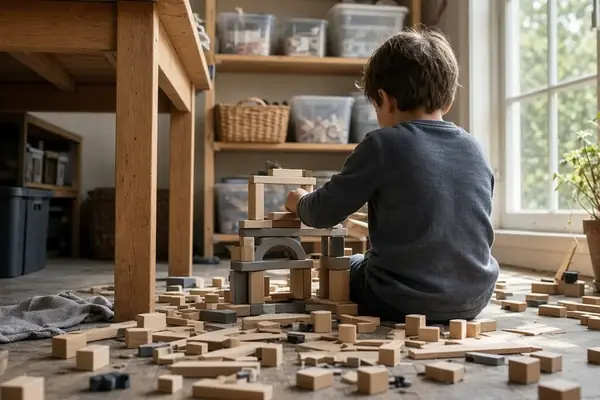
On the classroom rug, a tall block tower repeatedly fails at the third tier. The builder has been using cylindrical blocks as a base, watching them roll outward under the weight. After a moment of frustration, they reach for a 12-ounce cereal box and two standard 11-inch paper towel tubes, establishing new primary structural anchors. They shift to flat-mass blocks for the upper levels, carefully aligning the edges. The structure holds.