Abstract
Puppets occupy an unusual position in the study of early language: they are simple objects, yet they reliably draw children into the kind of back-and-forth exchange that speech development depends on. This review examines how puppet-based interaction shapes verbal output and narrative skill in young children, drawing on observational work conducted with children aged 36 to 48 months across sessions lasting 12 to 15 minutes.
The original protocol attempted to track gross motor activity alongside speech. That dual focus diluted the coding reliability of the speech transcripts, so the team narrowed its attention to verbal interaction alone. What follows is a synthesis of the mechanisms that emerged once the lens tightened—vocabulary expansion, narrative complexity, and the structure of conversational turn-taking.
Introduction
Imaginative play has long served as a proxy for studying how children rehearse the social and linguistic rules they will later use without scaffolding. Within that broad field, puppets present a distinct case. A puppet is both an object the child manipulates and a character the child addresses, and that doubling is precisely what makes it useful for language research.
The investigators defined puppet-based interventions narrowly. They excluded digital and screen-based avatars, reasoning that animated characters on a display remove the tactile and joint-attention elements that may carry the developmental weight. The intervention under study involved physical puppets handled in the same room, in shared sightline, with the child.
Scope of the language outcomes
The studies surveyed here were published between 2019 and 2022. Participating children carried baseline expressive vocabularies ranging from 200 to 250 words, placing them in a window where new word acquisition is rapid and observable over a matter of weeks. The outcomes considered were deliberately verbal: word count, utterance structure, and the rhythm of exchange. Motor and emotional measures, while relevant to play more broadly, fell outside this scope.
Methodology
The observational design followed a cohort of nearly 42 toddlers over an observation window spanning 8 to 10 weeks. Sessions were recorded and later transcribed by coders working independently of the facilitators who ran the play.
An early version of the protocol called for lapel microphones clipped to each child, the idea being that quiet vocalizations might otherwise go unrecorded. The team discarded this approach after the first week. The hardware distracted the toddlers, who pulled at the clips and treated the microphones as objects of interest in their own right, which contaminated the very interactions the study meant to capture. Room-based recording replaced it.
Participant selection
Children were recruited from educational settings rather than home environments, which gave the team consistent conditions and trained adults already present. Selection favored children within the target age band whose expressive vocabularies sat near the baseline range, so that gains could be compared across a reasonably uniform starting point.
Capturing the exchanges
Data collection centered on verbal exchanges between child and puppet, and between child and facilitator. Coders logged each utterance, its length, and its place in the conversational sequence. The unit of analysis was the interaction, not the individual word, which allowed the team to study turn-taking as a structure rather than a tally.
Key Findings
Across sessions, mean length of utterance shifted from 2.4 to 3.1 words. The change is modest in absolute terms and meaningful in context: at this age, an additional half-word per utterance often marks the move from labeling to describing.
Narrative complexity rose alongside it. Coders set a working threshold for 'complex' utterances—a single statement had to contain a subject, a verb, and a temporal marker. That definition was not imposed in advance; it emerged after the team reviewed transcripts from the first sessions and looked for a line that separated simple naming from genuine narration. Utterances meeting the threshold became more frequent as the weeks progressed.

Turn-taking as the engine
The clearest pattern concerned conversational turns. Interactions averaged 4 to 6 conversational turns, and the children's expressive gains tracked closely with the number of turns a puppet could sustain. The puppet's value, in other words, was not that it spoke—it was that it prompted the child to respond and then waited.
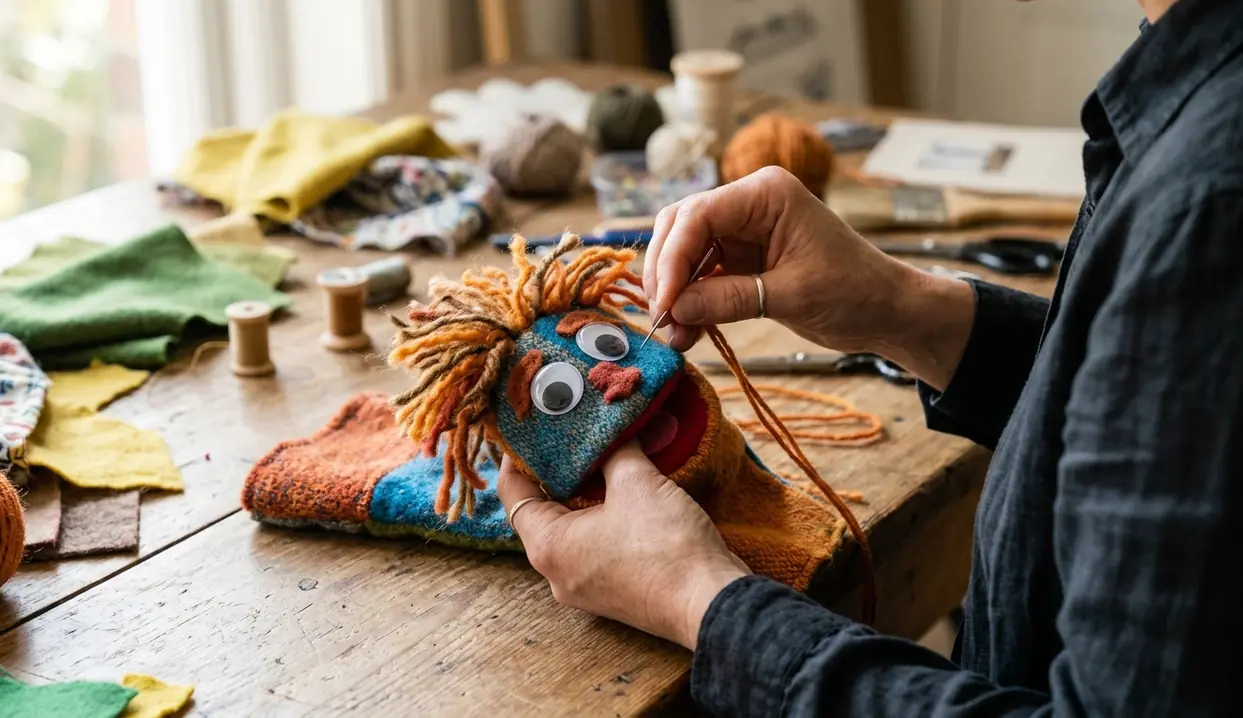
A hand puppet introduced without a distinct character voice tended to draw no reciprocal dialogue at all. Children treated such puppets as ordinary plush toys, handling them quietly rather than speaking to them. The voice, it appears, signals that the object is a conversational partner.
This detail matters for anyone hoping to reproduce the effect. The mechanism is not the puppet as an object; it is the puppet as a participant in a turn-based exchange.
Limitations
The findings should be read with their boundaries in view. Vocabulary gains manifested primarily in small-group settings of three to four children rather than in full-classroom circle time, where the available turns per child shrink and the puppet competes with many voices for attention.
Facilitator training introduced the largest source of variability. The authors chose to foreground this issue after cross-referencing transcripts and noticing a sharp divergence in turn-taking between sessions. Lead educators in the study had completed 4 to 6 hours of specialized workshop training; assistant caregivers received a standard 30-minute onboarding. Sessions run by the more thoroughly trained adults sustained longer exchanges, which complicates any clean attribution of gains to the puppet itself.
Context shaped outcomes in subtler ways too. The puppet's effectiveness as a linguistic bridge diminished sharply whenever the caregiver broke character to issue a behavioral correction. The shift from play voice to instruction voice appeared to collapse the pretend frame, and with it the child's willingness to treat the puppet as a partner.
Generalizability
The age band was narrow by design. Whether comparable effects hold for younger toddlers with smaller vocabularies, or for older preschoolers already producing complex sentences, remains an open question that this cohort cannot answer.
Implications for Practice
For caregivers, the practical reading is encouraging and specific. The puppet is not a passive enrichment object; it works when it is used as a conversational prompt and rests when the conversation ends.
Researchers developed their recommendations for structured use by examining where engagement dropped off. Leaving puppets loose in the general toy bin produced brief, non-verbal physical play and little speech—children manipulated them like any other plush item. Reserving the puppets for designated sessions preserved their novelty and their character.
Structured versus open-ended use
The data favored a rhythm of two to three sessions per week, in intervals of 10 to 12 minutes. Short and frequent outperformed long and occasional, which fits what is known about attention spans in this age group. That does not argue against spontaneous puppet play; it suggests that the measurable language benefits cluster around brief, intentional sessions where an adult holds the conversational frame.
Quick Tip: Give the puppet a consistent voice and keep that voice in character. The moment the puppet becomes a vehicle for "sit down" or "stop that," it stops being a conversational partner and the dialogue tends to dry up.
Fitting puppets into a wider framework
Puppet sessions align comfortably with broader developmental routines that already prize joint attention and reciprocal exchange. They are one tool among many, and the evidence here describes their effect within a particular age band, a particular setting, and a particular style of facilitation rather than a universal result.
Summary: Puppets support early language not through the object itself but through the turn-taking it invites. Brief, frequent sessions led by an adult who keeps the character intact, in small groups, produced measurable gains in utterance length and narrative structure—conditions worth replicating, and conditions worth remembering when reading the results.