The Hidden Costs of Skipping Daily Rhythm Play
Children who rarely share a live beat miss repeated practice in timing, word stress, turn-taking, and calm co-regulation. Later listening, early reading, and group play draw heavily on these foundational experiences. Caregivers treating singing as a special-event class give up the cheapest daily bonding tool they already possess. Recorded tracks playing in the background cost the motor-and-social coupling that live rhythm supplies. Background audio simply does not pull a child into the motor-and-social coupling that live knee-bouncing does, and that gap shows up later.
Roughly 15 to 20 minutes of daily co-regulated motor practice goes missing, and the shortfall adds up quickly when families rely solely on passive listening. Families also lose the four to six daily transition cues that live singing usually supplies. These cues signal shifts in the day, helping toddlers anticipate changes without anxiety. Live rhythm play demands physical presence. The adult and child synchronize their breathing, gaze, and physical movements to a shared pulse. That synchronization gives emotional regulation something to build on.
When a toddler feels the steady thump of a caregiver's hand on their back, their own nervous system begins to mirror that calm, predictable rhythm. The physical sensation of the beat provides a grounding anchor during moments of dysregulation. Skipping this daily practice leaves a void in the child's sensory diet. Without regular opportunities to synchronize with a caregiver, the child misses crucial practice in reading non-verbal cues. These micro-interactions—a shared smile on the downbeat, a synchronized breath before a crescendo—form the bedrock of social intelligence.
Building Memory and First Words Through Clapping
Call-and-response songs give toddlers a predictable slot to hold a phrase in mind and send it back. This active participation strengthens working memory. Clapping or tapping on syllables makes word boundaries easier to hear in running speech. Some early curriculum designers tested recorded metronomes to help toddlers identify word boundaries. They discarded the approach after observing that children under about 30 months routinely ignored the mechanical ticking. They pivoted entirely to caregiver-led knee-tapping. That approach supplied the warmth and eye contact needed to sustain the child's focus on the syllable breaks.
Name songs, cleanup chants, and bath-time verses attach new words to a felt pulse the child can join. Repeating a single short song for roughly a week to ten days running cements this auditory mapping. The child learns to anticipate the rhythmic structure, freeing up cognitive resources to focus on the vocabulary. Physical touch combined with rhythmic sound gives the child more than one channel to learn from. The brain processes the auditory input alongside the tactile sensation of the tap. This dual processing reinforces the neural connections responsible for language acquisition.
Marching and the Physical Path to Coordination
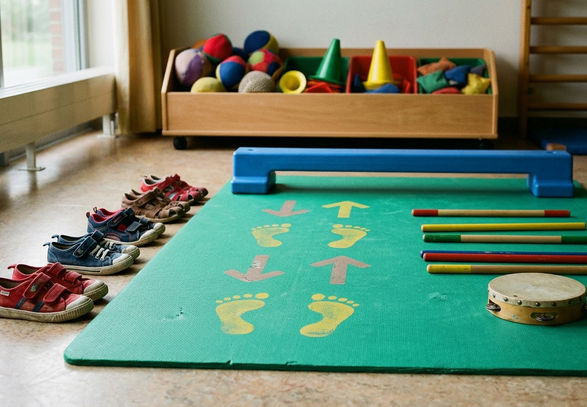
Swaying, marching, and freeze-and-go games couple balance, timing, and listening to one shared pulse. Scarves, ribbon rings, and floor spots invite crossing the midline. This physical crossing supports communication between the left and right hemispheres of the brain. Younger children need a slow, obvious beat to coordinate their gross motor movements. Older preschoolers can echo a short rhythm pattern on knees or a drum.
Tempos in the range of 100 to 115 beats per minute suit toddler marching. Short bursts of freeze-and-go games lasting three to five minutes work best before physical fatigue alters the child's posture. Maintaining proper posture ensures the child engages their core muscles effectively during the activity.
The physical exertion required for these games helps dissipate excess energy, leading to calmer periods of focused play afterward. Rhythmic movement requires the brain to predict the next beat and plan the corresponding motor action. This predictive processing strengthens neural pathways associated with motor planning and execution. When a child anticipates the freeze command in a song, they are actively engaging their inhibitory control networks. They must halt their momentum precisely on cue, a skill translating directly to stopping at a crosswalk or pausing before grabbing a peer's toy. Marching also demands bilateral coordination. The child must alternate their leg movements while maintaining their balance, a complex task for a developing nervous system. Adding a rhythmic auditory cue provides a temporal framework organizing these motor patterns. The beat acts as an external pacemaker, guiding the child's movements and smoothing out clumsy transitions.
Early Social Bonding Around the Frame Drum
A shared frame drum, shaker pass, or bell game trains waiting, volume control, and joint attention. Wait times of around four to seven seconds between turns during a shaker pass build impulse control. The child must inhibit the urge to grab the instrument until their designated turn arrives. Live, unamplified play keeps faces, breath, and laughter in the same circle. That physical proximity is where bonding concentrates. From playroom and classroom observation, the social glue is strongest when an adult joins as a fellow player alongside the children.
Introducing a shared frame drum builds joint attention effectively in small circles of two to four children. Scaling the same activity to groups larger than six tends to trigger sensory overload and grabbing behaviors. The increased noise and visual stimuli overwhelm the child's ability to track the turn-taking sequence. Small group settings allow the adult to monitor each child's engagement level and adjust the pacing accordingly. The shared focus on a single instrument creates a micro-community where every participant's contribution matters. Passing the shaker hand to hand becomes a tangible representation of social reciprocity.
Setting Realistic Expectations for Daily Music Play
Rhythm play is a daily practice supporting memory, language play, coordination, and closeness. This practice builds foundational skills alongside sleep, talk, and outdoor movement. Gains manifest as easier transitions, longer shared attention, and more confident joining-in. Shifts in transition compliance tend to show up somewhere between two and three weeks of consistent practice. The child learns to associate the specific song with the upcoming routine, reducing resistance.
Electronic toys that perform the song for the child shrink the work the brain and body would otherwise do. They cut child-initiated motor responses by approximately 60 percent compared with passive wooden instruments. Passive instruments require the child to generate the sound, fostering a direct understanding of cause and effect. The physical effort of striking a drum or shaking a maraca provides essential proprioceptive feedback. This feedback informs the brain about the body's position and movement in space. When a toy does all the work, the child becomes a passive consumer rather than an active creator of rhythm. The developmental benefits of music play stem from the active engagement of the child's motor and cognitive systems. Pressing a button to hear a pre-recorded melody bypasses this essential work. The child learns that music is something happening to them, rather than something they produce through their own physical effort. That distinction shapes whether active music-making sticks.
Structuring Home Rhythm Baskets Versus Classroom Corners
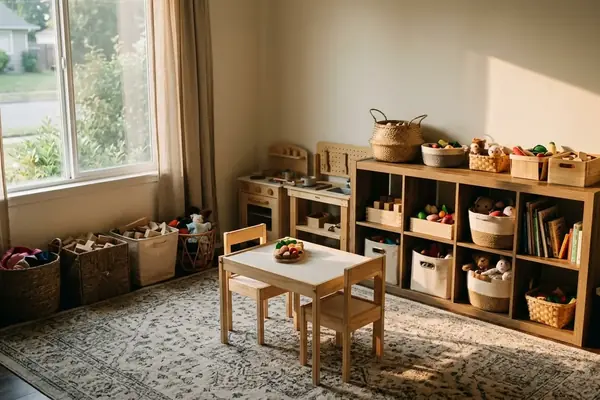
A home rhythm basket holds roughly five to seven distinct percussive items. This typically includes two egg shakers, one small frame drum, one set of wrist bells, one play scarf, and wooden spoons. Home use relies on short sung lists of family songs serving daily routines. Keep shoes-on transition chants to about ninety seconds, before toddler attention fractures. Brief chants let the child finish the task before losing focus.
A classroom corner features the same core toys plus a defined circle, a visual turn-taking cue, and volume rules. These rules ensure one drum does not flood the room with sound. Clear boundaries in the classroom corner shape how children explore it. Visual cues, such as a designated rug or seating arrangement, help children understand the expectations for the space. The home basket offers flexibility. It moves from the living room floor to the kitchen counter, integrating rhythm into the natural flow of family life. Keeping the item count low prevents decision fatigue, allowing the child to focus deeply on the acoustic properties of a few well-chosen tools. A single egg shaker offers a surprising range of sounds depending on how it is held and moved. By restricting the options, caregivers encourage deeper exploration of each instrument's potential. Larger group dynamics in the classroom call for more formal structures. Visual turn-taking cues, such as a passing object or a designated speaker's spot, help manage the increased social complexity. These environmental supports ensure every child has an opportunity to participate without overwhelming the group's collective attention.
A Twenty-Minute Saturday Rhythm Session You Can Copy
This is a fully worked case for a 22-month-old and a four-year-old in a living room, using one scarf, two shakers, and one frame drum. The session runs about twenty minutes, broken into three- to six-minute activity blocks.
- Minute 0 to 3: Begin with a hello song using names and a gentle bounce. If the toddler leaves, the adult keeps the pulse going until they return. Maintaining the beat provides a welcoming anchor for their eventual re-entry. The steady rhythm signals that the activity continues, offering a secure base for exploration.
- Minute 3 to 8: Initiate a shaker pass around a rug circle. Transition into freezing when the singing stops. The four-year-old gets one turn as leader, setting the tempo for the group. This leadership role fosters confidence and requires the older child to consider the pacing needs of the younger sibling.
- Minute 8 to 14: Introduce the frame drum for a targeted volume exercise. The adult models a quiet tap, passing the drum to the four-year-old, then the toddler. The contrast between loud and soft strikes requires precise motor control and attentive listening.
- Minute 14 to 20: Conclude with a scarf swaying activity to a slower, calming melody. The visual tracking of the falling scarf signals the end of the active session. The slow, sweeping motions help lower heart rates and transition the children back to independent play.
Run that same sequence three Saturdays in a row before introducing new songs, and by the third week the 22-month-old will often reach for the scarf on their own once the slower melody starts.