A completed 24-piece board tells a caregiver something narrow and useful: this child can handle that particular combination of image, cut, join, and theme at that number of pieces. The reasonable next move is to stay there and change what the pieces ask for. Piece count works better as a plateau to occupy than as a ladder to climb, because a single count can host wildly different levels of difficulty depending on how the picture is drawn and how the pieces are shaped.
The habit this argues against is familiar in any toy aisle. A child finishes a 48-piece farm scene on a Tuesday, and by Saturday there is a 100-piece box on the shelf. The count went up; nothing else was examined. Sometimes that works. Often it produces a board the child dumps out, pokes at, and leaves.
What follows is a sequence that can be run at home in a week: read the board the child already owns, sort the shelf into fluent, stretch, and waiting trays, advance exactly one lever, and hint in a way that leaves the final fit to the child.
Reading the Board a Child Already Knows
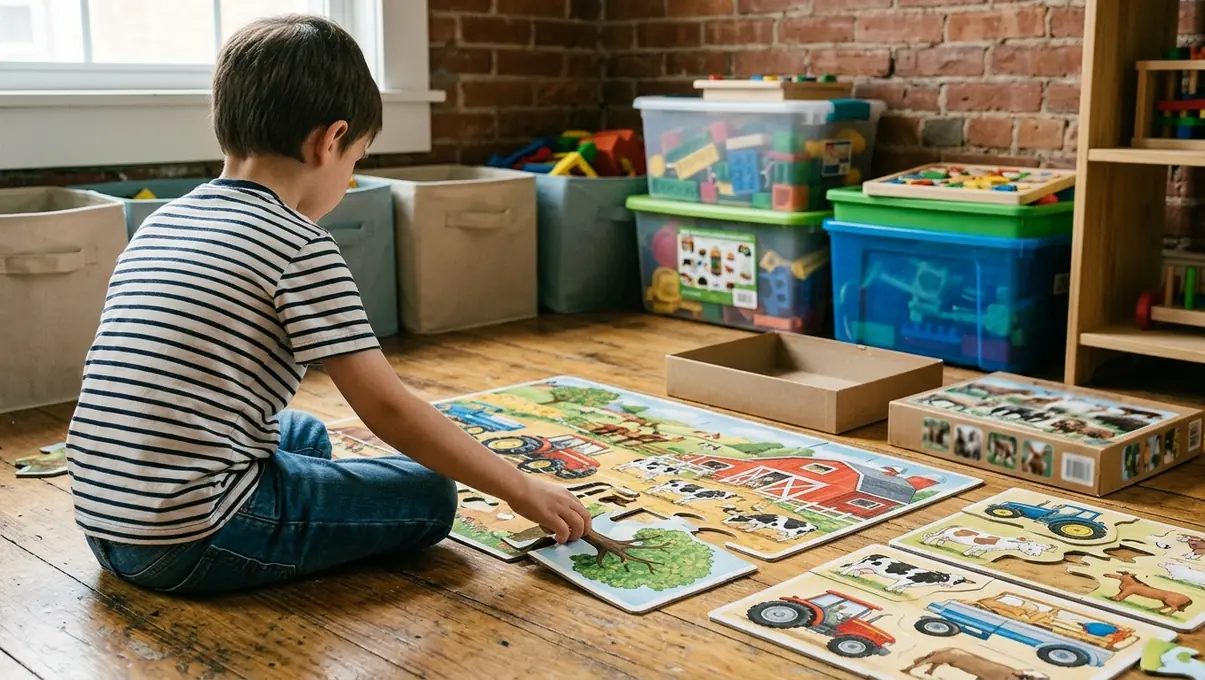
Observation costs nothing and settles most purchasing questions. Set out a puzzle the child has done several times and watch the opening minute. Does the work begin immediately, or does the lid sit unopened while the child looks around? Does the child build the frame first, or chase a patch of red until it runs out? How often does a piece get pressed into a slot it plainly does not fit? Is the lid picture propped up in view, and does the child consult it, or has the image been memorised?
Two readings matter most. A clean finish with energy left over signals fluency at that count. That is the moment to change a different variable, not to double the pieces. The opposite signal is equally legible: approximately three to five minutes of continuous force-fitting, or the child leaving the table within eight to twelve minutes of starting, indicates the current mix already sits above comfort. The correction is a step back in image complexity, even when the age band printed on the box says otherwise.
Worth stating plainly: this is a kitchen-table heuristic for managing a home play shelf, and it carries none of the weight of formal spatial or developmental screening. It answers the question of which box to hand over next, and nothing larger than that.
Image Density, Cut Style, and Join Type as Separate Dials
Three properties vary independently of piece count, and a fourth — theme familiarity — often varies without anyone noticing.
Image density
At the easy end sit large blocks of flat colour and simple drawings: a cartoon barn, a tractor, four animals with clear outlines. At the demanding end sit busy photographs with repeated textures, where sky, foliage, and gravel each supply dozens of near-identical fragments. Two 12-piece puzzles can differ enormously here. A 12-piece farm cartoon is a sorting task; a 12-piece photo puzzle is a texture-matching task.
Cut style
Regular ribbon-cut interlocking pieces produce a predictable grid, and children learn to read the frame from the straight outer edges. Irregular organic cuts hide that structure, so the border stops announcing itself and the child must reason from the image instead. Introducing an organic cut only after ribbon-cut fluency at the same count keeps the added load on one axis.
Join type and piece shape
Standard two-in-two-out pieces give consistent tactile feedback: knobs and sockets alternate, and a wrong fit feels wrong. Wild knobs, thin necks, and look-alike silhouettes remove that feedback. Pieces that appear interchangeable force visual checking where touch used to suffice.
Cut-Style Sequencing
When two boards share a piece count, compare their cuts before their pictures. A 48-piece organic-cut board and a 48-piece ribbon-cut board are not equivalent purchases, and shelving them together invites accidental double jumps.
Three Trays Instead of a Shelf Sorted 12 to 100
Most puzzle shelves start out organised by size, ascending left to right from 12 pieces to 100. That arrangement collapses the moment a child stalls on an unfamiliar 24-piece theme while finishing a familiar 48-piece board without help. Size ordering describes the box; it says little about the child.
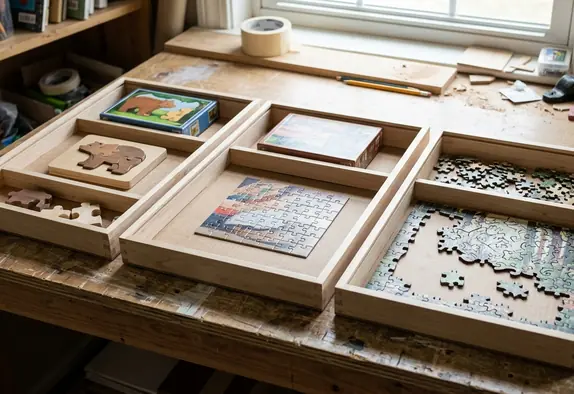
A three-tray system tracks mastery instead:
- Tray 1, fluent. Puzzles the child finishes at the current count with little or no help. These stay in rotation; repetition is where confidence lives.
- Tray 2, stretch. Puzzles that change exactly one lever while the count holds steady. This is the working tray, and it should usually contain only two or three boards.
- Tray 3, waiting. Puzzles that change two levers at once, or raise the count. Visible on the shelf, deliberately out of the daily rotation.
Keeping Tray 3 in sight matters. Children notice what is coming, and anticipation does useful work that a hidden cupboard cannot.
Advance One Lever, Hold the Other Three
The rule is arithmetically simple: once fluency is confirmed, change one of image density, cut style, join type, or theme familiarity, and hold the remaining three constant along with the piece count. A child who breezes through a cartoon farm at 48 pieces moves to a busy photograph at 48 pieces, still ribbon-cut, still standard joins.
Pieces get added only after all four levers feel fluent at that count. When the count does rise, the other levers drop back toward their easier settings, because the new number is doing the stretching.
Frustration Stack Alert
The box that reliably ends in tears combines three changes at once: more pieces, a busier photograph, and an unfamiliar cut. Each alone is a reasonable step. Together they read to a child as a wall.
Hinting Without Placing the Piece
Stalling is not a signal to take over. A four-step hint ladder keeps the final decision where it belongs. Point to a region of the board. Name one visible feature in that region: "there's a bit of yellow roof missing here." Pick up a candidate piece and rotate it ninety to a hundred and eighty degrees on the table, where the child can see the orientation change. Then stop.
The move to refuse is the rescue: completing a corner or running the whole edge "just to get them started." It removes the most instructive part of the task, since edge assembly is where children learn that shape carries information.
One pattern shows up repeatedly on home shelves: an adult narrates a matching strategy aloud exactly once, then sits back and says nothing further. The child, having heard the strategy modelled rather than executed, makes the fit. The narration transfers; the placement does not.
The Next Box You Hand Over
Occupy the piece count the child already owns, and spend the whole stretch on a single other lever, leaving two or three untouched.
So which one will it be on the next box — the picture, the cut, the joins, or the theme, and which two are you willing to leave exactly as they are?