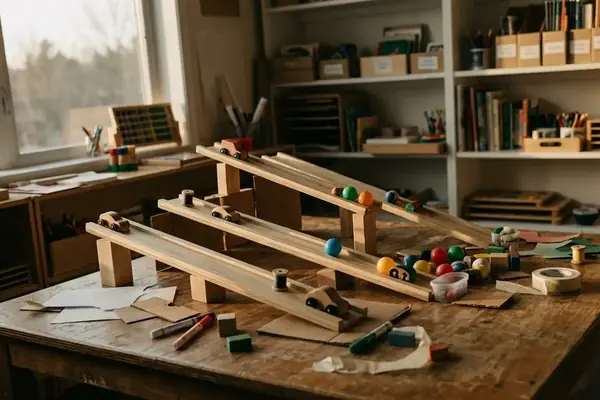
When Pretend Play First Takes Root
Somewhere around 18 months, a child picks up a spoon, holds it to a doll's mouth, and something shifts. That small gesture — feeding a toy that cannot eat, marks the arrival of symbolic thought. The CDC developmental milestones for pretend play place this simple pretend at roughly a year and a half, and it is the moment a play corner earns its keep.
The challenge is that this first gesture is only the beginning. The same child who mimics feeding a doll at eighteen months will, within a few years, be narrating a rescue mission that spans an entire afternoon. A well-built corner has to stretch across that whole arc.
Design the infrastructure to span a developmental window of roughly 4 to 6 years, from toddlerhood through early elementary. Buy the structure once; swap the contents often. This guide walks through layout, storage that scales, prop kits by age, a rotation cycle, safety boundaries, thrifty additions, and one fully worked home setup you can copy against your own wall.
How Pretend Needs Shift From Toddler to Early Elementary
A single corner has to serve three very different players, because attention and narrative complexity change dramatically across these years.
Toddler: single-action imitation
At age two, play arrives in bursts of three to five minutes and centers on one action repeated: stirring a pot, brushing a doll's hair, rolling a truck. Props should be large, safe, and forgiving. Costume cues are unnecessary here; the child is imitating, not casting a role.
Preschool: multi-role scripts
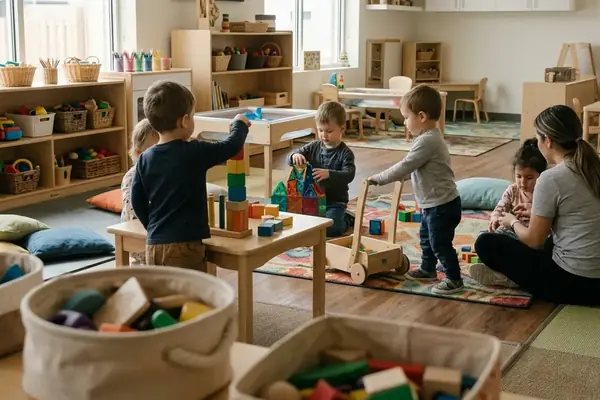
By the preschool years, play splits into roles. A tabletop becomes a shop, then a clinic, then a kitchen within the same session. Costume layers that hint rather than dictate — an apron, a vest, a length of cloth, let a child slide between characters. Simple furniture that transforms matters more than any fixed themed toy.
Early elementary: longer arcs and loose parts
By age six, narrative arcs can run 20 to 45 minutes, and children begin building sets rather than using ready-made scenes. Early elementary play typically calls for three to four loose parts that can be repurposed — a cardboard tube becomes a periscope, then a chimney, then a rocket. Add writing and drawing supports here, because stories now want tickets, signs, and maps.
This trajectory is exactly why fixed single-purpose toys age out. A wooden play kitchen often becomes a dead zone by age five, because it cannot easily transform into a spaceship or a post office.
Pick a Footprint That Survives Furniture Reshuffles
A dedicated playroom sounds appealing until you watch a toddler abandon it. Isolated rooms tend to see less use for the youngest children, who need to stay within sight of a caregiver. The stronger choice is a bounded zone inside a shared living space.
Good candidates: a quiet wall near the living area, the space under a window, or a spare closet alcove. Each stays visible enough for supervision while feeling contained enough to focus attention.
Give the child a minimum usable rectangle of 1.2 by 1.5 meters so they can sit, kneel, and turn without knocking a wall. Traffic matters too — leave at least 80 cm of clearance between the play boundary and any room exit so the corner never blocks a doorway.
Define the "stage" without renovation. A rug sets the floor boundary. A vertical backdrop — a pegboard, a low shelf, or a hung fabric panel, signals where the imagined world begins. None of it requires a drill through a load-bearing wall.
Build the Skeleton: Furniture and Storage That Scale
Reading engagement before you swap
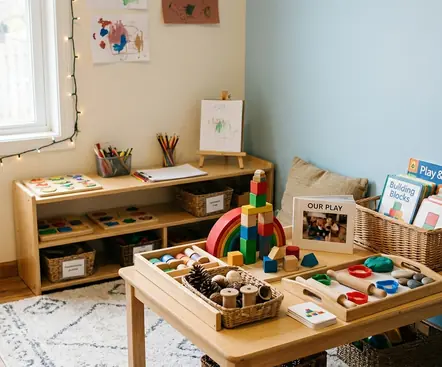
The four pieces that carry the corner
- One low open shelf
- One dual-use table or a stack of crates
- Wall hooks for costumes and bags
- Labeled bins carrying both a picture and a word tag
Modular crates, baskets, and a plain tabletop outlast a fixed play kitchen for one simple reason: they reconfigure. A crate is a stove today and a spaceship console next month. A themed kitchen is only ever a kitchen.
Height progression
Start the shelf at 30 to 40 cm for toddlers doing floor and kneeling play. Transition toward a 50 to 60 cm table height as the child reaches early elementary and shifts to seated work. Keep the active set within a 60 cm arm's-reach radius, and move resting props to higher storage the child cannot casually flood the space with.
Stock Three Prop Kits Instead of One Permanent Theme
Group props into three kits matched to cognitive milestones. Each kit holds four to six open-ended items — think four blank paper pads or three loose fabric squares, rather than a single elaborate toy.
| Age Band | Core Focus | Example Props | Storage Method |
|---|---|---|---|
| Toddler (18m – 3y) | Single-action imitation | Soft food, large vehicles, doll brush, one simple costume piece | Low open floor baskets |
| Preschool (3y – 5y) | Multi-role scripts | Cash register or menu cards, doctor bag, tool belt, 2–3 costume layers, blank paper pads | Labeled bins at kneeling height |
| Early elementary (5y+) | Longer story arcs | Maps, tickets, clipboards, loose fabric, cardboard architecture, name tags | Higher shelf, resting rotation |
Preschool kits deliberately introduce two or three costume layers that suggest a role without locking in a character. An apron reads as chef, shopkeeper, or painter depending on the day. That openness is the point.
Run a Simple Rotation Cycle So the Corner Feels New
Novelty comes from rotation, not from buying. Run a two-bin active, one-bin rest model: two bins out and in play, one bin resting out of sight, cycling on a roughly 10 to 14 day calendar cue.

Swap on evidence, not the calendar alone. Watch for a three-to-four-day pattern of a child walking past a specific bin before you rotate it out. Pulling something too soon interrupts a story that is still building.
One caution for older children: rotation frequency should slow as they reach early elementary. Swapping a complex ongoing storyline too early causes frustration rather than renewed interest — the practical read on this comes from tracking where engagement drops off rather than where the calendar says to move.
Pair swaps with seasonal or family-life themes to refresh the corner without new purchases. A winter theme reframes existing fabric as scarves and snow.
Set Safety Rules That Still Leave Room to Invent
Boundaries make independent play possible, so build them to protect without smothering the story.
By age band, watch four hazard types: choking, tip-over, cords, and costume trips. For any child under 36 months, exclude items smaller than about 3 cm in diameter. Keep breakables and real kitchen tools out of the kit until a child clearly shows readiness.
Anchor Before You Stock
Anchor tall pieces to the wall before a single prop goes in. Anchoring into drywall requires finding a stud or using heavy-duty toggle bolts. Standard plastic drywall anchors will fail under the weight of a climbing child.
Hygiene for shared props
Fabric costume pieces and mouthable props get shared, so wash fabric costumes every 14 to 21 days to keep them clean for the next round of pretend.
Stretch the Budget With High-Yield, Low-Cost Additions
The richest props often come from the recycling bin. Clean, empty food cartons — oatmeal tubes, egg cartons, mimic real-world shapes and textures. Rotate three to five of them in on a monthly basis as fresh "stock" for a shop or building blocks for cardboard architecture.
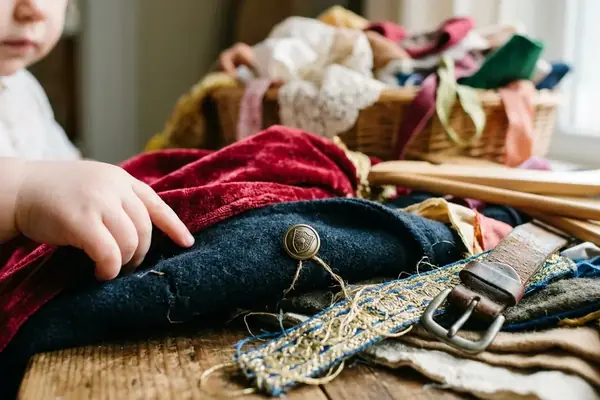
Printable menus, tickets, and signs cost almost nothing, and letting the child help make them deepens ownership of the play. Fabric scraps of at least 45 by 45 cm work as instant costumes, store awnings, or superhero capes; clothespins turn them into whatever the moment demands.
Invention Over Purchase
When a child stalls, resist filling the silence with a new toy. Place a "problem prop" and wait 60 to 90 seconds before offering a verbal prompt. A small mirror or felt board angled at 45 degrees to the main surface invites the child back in from the side.
One Corner You Can Copy This Weekend
Here is the whole system mapped to a small living room, proving a full corner does not need a suburban house.
- Claim the wall. Take a 1.2 m wall span in the living room. Lay a 1 by 1.5 m rug to mark the floor boundary and check for 80 cm of clearance to the nearest exit.
- Set the skeleton. Place one low shelf at 30–40 cm against the wall. Anchor it into a stud. Add wall hooks above for costumes.
- Load four bins. Two active bins on the shelf, one resting out of sight, plus one for loose parts. Tag each with a picture and a word.
- Stock by age. For a three-year-old, that means the preschool kit: menu cards, a doctor bag, two costume layers, and a pad of blank paper — four to six open items, no more.
- Add recycled stock. Drop in three clean cartons as shop inventory, rotated monthly.
- Run the ritual. Each morning, open the corner; each evening, reset it. The daily open-and-close is built to take a caregiver three to four minutes, short enough that the system actually sticks.
Watch for the walk-past pattern over the next two weeks. When a bin sits ignored three or four days running, rest it and bring the third bin forward. That single wall, four bins, and a rug will carry a child from feeding a doll to charting a rescue map.