On This Page
Quick Nav
- The Moment a Hat Changes How a Child Speaks
- What Social and Emotional Skills Get Rehearsed in Costume
- Building a Dress-Up Collection That Invites Every Child In
- Conversation Prompts That Stretch Empathy Without Hijacking the Story
- Supporting Shy or Reluctant Children at the Costume Box
- Practicing Routines and Everyday Problem-Solving Inside a Story
- What Will You Put in the Bin First?
The Moment a Hat Changes How a Child Speaks
A child puts on a soft nurse’s cap, picks up a toy phone, and lowers their voice. “Tell me where it hurts,” they say. A minute earlier, that same child was asking an adult to fix a stuck zipper. Inside the costume, the language shifts from requesting care to offering it.
This shift reveals the central value of dress-up play. Clothing and props give children a low-stakes place to rehearse social scripts they have heard at home, in classrooms, and around their community. The hat signals a role; the role supplies a reason to listen, respond, and make decisions.
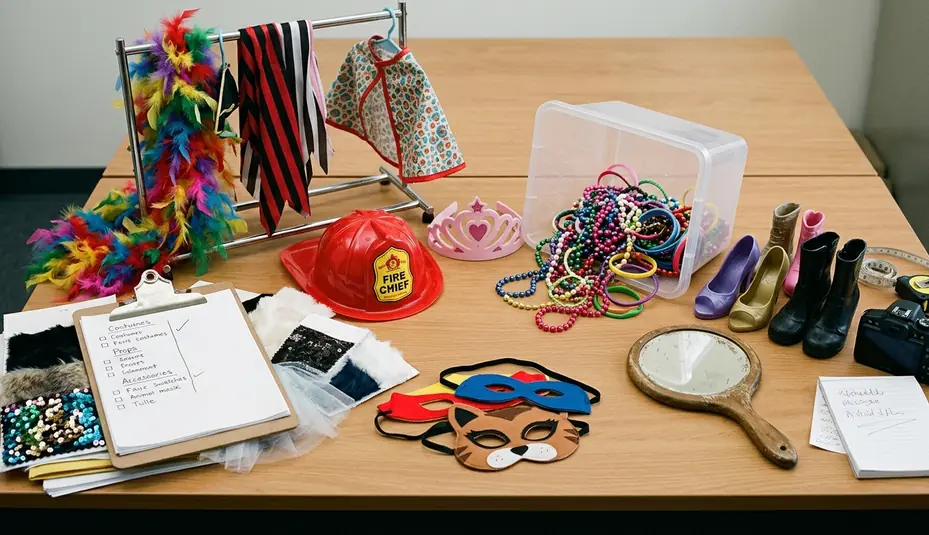
Costumes support developmental play when children can shape the story themselves. Over the course of one scene, they may practice empathy, negotiate roles, recall the sequence of a familiar routine, and repair a plot that has gone sideways. The sections below move from those underlying skills to the practical work of stocking a flexible costume bin, prompting conversation, and welcoming children who prefer to watch before joining.
What Social and Emotional Skills Get Rehearsed in Costume
Dress-up creates a temporary point of view. A child wearing a doctor’s coat has to notice the “patient’s” cues: Is the patient frightened, impatient, or pretending to sleep? The child then adjusts the character’s words and tone. That exchange is a concrete form of perspective practice.
Four Skill Clusters
- Empathy: considering what another character sees, feels, or needs.
- Cooperation: choosing roles, sharing popular pieces, and pursuing a common story goal.
- Routines: organizing the steps of a job, journey, meal, or family scene.
- Problem-solving: finding a substitute prop, changing the plan, or repairing a disagreement.
Cooperation begins before the story does. Three children may all want to drive the pretend bus, while nobody wants to be a passenger. They have to negotiate casting, decide when roles will rotate, and agree on what counts as reaching the destination. These decisions give abstract social expectations a visible purpose.
Role Before Costume
Look for what the child is doing with the role, not how accurately the outfit represents it. An apron can belong to a baker in one story and become a superhero cape in the next. Both uses require the child to establish meaning and communicate it to other players.
Adults can learn more by observing the sequence than by judging the final scene. Notice who proposes the first idea, who changes it, how children divide materials, and what happens when the shared plan breaks.
Building a Dress-Up Collection That Invites Every Child In
A useful collection leaves room for interpretation. I look first for pieces that can carry several meanings, because they allow children to enter the same material through different interests and emotional needs.
Pre-packaged career sets may offer immediate role recognition, yet highly specific pieces can narrow the possible story. Open-ended materials give a child more control. A length of cloth can become a cape, skirt, blanket, river, baby carrier, or market awning without requiring a prescribed character.
Starter Checklist for an Inclusive Dress-Up Bin
- Add three to four fabric lengths, each roughly 36 to 48 inches, for wraps, capes, skirts, and scenery.
- Include everyday adult clothing such as oversized button-down shirts, aprons, soft hats, and tote bags.
- Choose community-helper props that signal care or work, including toy stethoscopes, clipboards, and canvas bags.
- Offer multiple ways to represent a role. A veterinarian might use a coat, badge, bag, or toy phone.
- Check seams, closures, and weight. Favor soft materials, easy fasteners, and pieces that fit over ordinary clothes.
- Provide non-face-covering choices for children who dislike masks or restricted vision.
Cultural and gender flexibility begins with how the collection is presented. Store related pieces loosely rather than assembling a single “correct” outfit. Children can then combine a scarf, work shirt, and clipboard without receiving a fixed message about who may perform a particular job.
Too many pieces can bury the useful ones. A rotation every two to three weeks keeps the bin legible while introducing fresh story possibilities. Rotate a few props, retain familiar open-ended fabrics, and watch what changes in the children’s play before adding more.
Conversation Prompts That Stretch Empathy Without Hijacking the Story
The timing of an adult question matters as much as its wording. Join at the edge of the scene, mirror a phrase the child has already used, and offer one open question. Then wait. A chain of questions quickly turns imaginative play into an oral quiz.
Prompts That Leave Room
- “What does your character need right now?”
- “How can we help the other player’s character?”
- “What should we try if the plan doesn’t work?”
- “How will your character know it is their turn?”
Specific scenes make these prompts easier to use. At a pretend restaurant, the server brings the wrong order. Ask, “How could the customer explain what they expected?” The children might remake the meal, trade plates, or turn the mistake into a new special.
During a lost-pet search, try, “Where might the pet go if it felt scared?” A child may decide to speak quietly, leave pretend food nearby, or recruit another player as a neighbor. On a rainy-day bus ride, ask, “Who needs a dry place to sit?” The players can rearrange seats or invent an umbrella from a scarf.
Pause After Asking
Let the story absorb the prompt. Children may answer through action instead of speech, and that action often shows more about their understanding than a direct verbal response would.
Families seeking a broader foundation for this approach can consult NAEYC resources on the power of play.
Supporting Shy or Reluctant Children at the Costume Box
Watching is often a child’s first rehearsal. From the edge of the group, the child learns the story’s rules, identifies predictable roles, and judges whether entering will feel manageable.
Offer one or two low-demand props at a time: a badge, small scarf, clipboard, or toy phone. A child can also hold a prop for another player, choose music for the scene, or announce when the pretend shop opens. These peripheral roles create genuine participation without requiring a full costume.
The Dispatcher’s Entry
Consider a child who refuses every item in the bin but accepts a toy phone. An adult names the role “dispatcher” and asks the child to tell the firefighters where to go. The child remains outside the costume box while contributing information that moves the shared plot forward.
Once the story feels predictable, the dispatcher may accept a badge. Later, a soft hat might become useful because it belongs to an already familiar role. The progression follows the child’s sense of safety rather than an adult schedule.
After offering an opening, wait a few seconds before intervening again. Slower processors may need that quiet interval to decide how to enter the narrative.
Watch the Wider Pattern
These gentle entry points address typical developmental hesitation. Avoidance that persists for several months and appears alongside broader social distress warrants discussion with pediatric or school support professionals.
Practicing Routines and Everyday Problem-Solving Inside a Story
Dress-up stories encode sequences. Opening a clinic involves arranging supplies, greeting a patient, asking what happened, and offering care. A pretend trip requires choosing a destination, packing a bag, checking tickets, and deciding how to travel.
A dedicated weekly open-bin window of roughly 30 to 45 minutes can make this developmental play predictable. Children know when the materials will appear and have enough time to build a story beyond its opening scene.
Keep Scaffolds Inside the Fiction
When a problem appears, speak from within the imagined situation:
- “The bridge is closed. What is another way home?”
- “The clinic has no bandages. What could the doctor use?”
- “Two captains have the same cape. How will the ship decide who goes first?”
- “The shop is busy. What job could the next customer do while waiting?”
These prompts preserve the purpose of the play while drawing attention to substitution, sequencing, and conflict repair. A lecture about sharing pulls children out of the story. Asking how two captains will run one ship gives them a reason to solve the same social problem from inside it.
Missing props are especially productive. A block can become a phone, a scarf can mark a river, and a tote bag can carry medical supplies in one scene and groceries in another. Constructive play and imaginative play meet here: children assign a function, test whether other players understand it, and revise the symbol when communication fails.
What Will You Put in the Bin First?
Costumes work best as tools for empathy, cooperation, routines, and repair rather than as performance pieces. A flexible prop gives children authority over the role, while a patient adult leaves enough space for the social work of the story to unfold.
Which single open-ended piece will you add this week so a hesitant child can enter play on their own terms?