The Second Request for the Same Book Signals Readiness
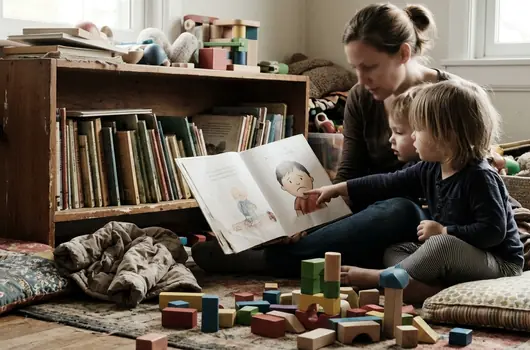
A child who brings the same picture book to the reading chair for the fourth night in a row is doing something useful. The request shows that the story has become a stable frame, something the child can hold without effort. That stability is the condition under which attention can move toward words, causes, and the back-and-forth of talk.
Many adults read the request differently. They treat it as a comfort habit, pleasant but static, or as a stall in development that only a new title can repair. That reading is understandable. Adults tire of a book long before children do, and novelty feels like progress. It leads caregivers to swap the book just when the child is ready to get the most from it.
The difference becomes clear when a first encounter is compared with a later one. On a first reading, a young listener spends most of the available attention on orientation: who is present, where the action takes place, what happens next. Each page turn brings uncertainty, and resolving it uses up the effort. By the fifth or sixth reading, that work is finished. The child already knows the character reaches the tree and already knows the rain arrives. Attention that once went to tracking events can now settle on a single verb, a change in a character's expression, or the reason behind a choice.
On this view, the repeated request is the child arranging the conditions for deeper learning. The adult's task is to recognise that and use it.
From Chiming In to Using "Umbrella" at the Front Door
Word learning across rereadings tends to happen on three layers, and all three can appear in a single sitting.
- Joining the line. The child chimes in on a familiar sentence, often word for word, carried by its rhythm.
- Pointing to the picture. On hearing a word, the child locates the matching object in the illustration.
- Using the word elsewhere. The child takes the word out of the book's sentence and uses it in an original remark.
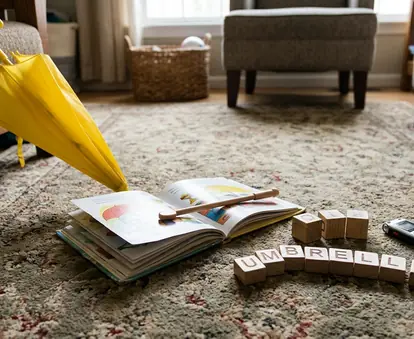
The first layer can look like vocabulary when it is closer to recitation. The third is the real sign of ownership. A child who says "umbrella" while pointing to rain gear by the door, with no book open, has carried the word into daily life.
A known page supports this progression for a simple reason. When the child does not need to work out what comes next, the child can stay on one illustration as long as interest lasts. That pause allows a label to attach to more than a thing. It can attach to an action and a use, and those links make a word sturdier and easier to recall in new settings.
Consider a sample page, invented for illustration: a red umbrella held up against painted rain. On the first pass, the adult and child simply name the object. On a later pass, the adult asks what the umbrella does to keep the character dry. Once the plot is secure, the adult asks what would change if the umbrella were left at home. Each question keeps the same picture but asks more of the word, moving it from a label toward a concept the child can reason with.
Plot Recall Is Where Understanding Starts
The earliest comprehension gain from a familiar book is plot recall. The child can say what happens, often in the right order. Adults sometimes stop there, treating recall as proof that the story has been understood.
Recall is a foundation. Later readings can build three further components on top of it:
- Cause: why a character leaves a place or makes a choice.
- Order: which event had to happen first for the next to make sense.
- Feeling: how a character's face or posture shifts from one page to the next, and what that shift means.
Two kinds of question show the difference. A memory check asks for an isolated visual fact: What colour is the umbrella? The answer sits on the page, and a child who has seen the book twice can supply it. A link question asks the child to connect two parts of the story: Why does she stop under the tree? Answering requires the rain, the wet coat, and the shelter of the branches to be held together at once.
Memory checks still have a place, especially with a new title. On a familiar book, though, they leave most of the child's freed attention unused. One technique bridges the two well. The adult pauses just before turning to a known plot turn and waits, letting the child predict what comes next from the story's own logic. A correct prediction rests on understanding cause and order, even when the child phrases it simply.
Handing Over the Telling, One Pass at a Time
Participation in shared reading usually grows along a recognisable path. The child listens quietly, then joins a refrain, then answers when asked, and finally starts a comment or turns the page without being prompted. Each step gives the child a larger share of the conversation.
That growth depends partly on what the adult leaves open. An adult who fills every pause leaves the child nothing to claim. Two habits make a difference: a consistent daily reading time, so the routine itself is predictable, and a deliberate silence of a few seconds after turning each page. In that gap, the child can take the turn before the adult speaks.
A sample exchange across three passes of the umbrella scene, constructed for illustration, shows the transfer in practice.
- First pass. The adult reads, pauses, and the child supplies the next event: the rain starts.
- Second pass. At the same page, the child offers a reason: she steps under the tree to stay dry.
- Third pass. Looking at the character's slumped shoulders, the child supplies a feeling word, perhaps "sad" or "cold".
Across the three passes the adult says less each time, and the child moves from naming events to explaining and interpreting them.
Waiting Is Teaching
The silent pause after a page turn often feels awkward to adults. It is also the moment a child most often begins a comment unprompted. Count slowly before speaking.
Four Ways to Ask Something New of a Familiar Page
To deepen talk without turning reading into a quiz, the adult keeps the book and the routine the same and changes one thing: the type of question. One shift per sitting is enough.
From naming an object to its purpose
The adult moves from "What is that?" to what the object is for. Sample question: "What does the umbrella do when the rain falls?" Sample reply: "It keeps the water off his head."
From what happens to why
The adult moves from events to their causes. Sample question: "Why did she run under the branches?" Sample reply: "Because her coat was getting wet."
From plot to feeling
The adult asks how a character feels and what in the picture shows it. A sample reply might be: "Sad, because his mouth is turned down and he dropped his hat."
From the printed line to the child's retelling
On one page, the adult holds back the sentence and invites narration: "Tell me what is happening here in your own words." A child might answer, "The rain stopped so she folded the red umbrella up."
One Shift Per Sitting
Asking a shifted question on every page breaks the story's flow and makes the routine feel like an interrogation. Pick one page and one shift, then let the rest of the book simply be read.
Reading the Signs That a Favourite Has Run Its Course
A familiar book eventually stops doing developmental work, and children usually make this plain. The child closes the cover mid-reading, slides off the seat, answers prompts with flat single words, or carries a different book to the chair.
These signs call for change. Pressing on with more questions about the old book, especially after flat replies, turns a cooperative routine into a performance the child is trying to escape. The better response is to offer something new and let the child's interest lead.
A related case needs a different response. Sometimes a child still asks for the favourite but resists a harder question, such as a cause or feeling prompt. Here the book is still wanted and the demand is not. The adult can drop the question for that sitting, return to shared recital, and try a simpler purpose question next time.
When the child does choose another book, one adjustment matters: follow that choice the same day, and begin with simple naming of objects on the page, leaving behind the causal and retelling questions that suited the old favourite. The new story has no stable frame yet, so the child's attention is back on orientation.
Keep the Book, Change the Question
On the next sitting with a well-worn favourite, pick a single page where the child already knows the plot turn by heart. After turning to that page, count slowly before speaking to give the child a few seconds of deliberate silence. If the child does not start a comment unprompted, introduce just one shift for that reading—moving from naming the red umbrella to asking what it does when the rain falls, or asking why the character ran under the branches—and then let the rest of the story simply be read.