Quick Nav
- A Low Table, Three Children, and a Pile of Blocks
- What a Toy Needs During Solitary and Parallel Play
- From a Shared Bin to a Shared Plan
- How to Set the Floor, and When to Sit Down Beside It
- Three Play Corners and What Each One Asked of the Children
- Buy for the Play You Can Already See
A Low Table, Three Children, and a Pile of Blocks
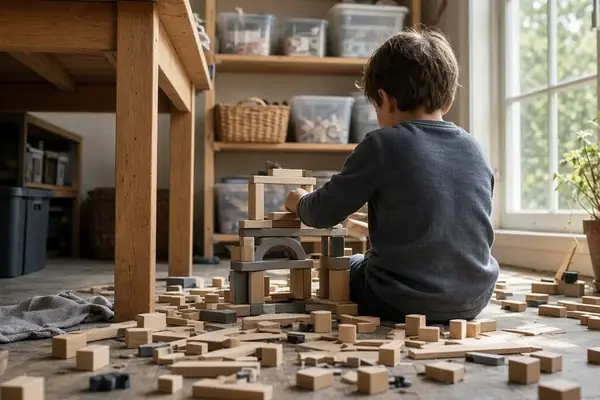
It is Saturday morning, and a low living-room table, somewhere between 14 and 16 inches high, holds a scatter of wooden unit blocks. One child stacks alone, absorbed. A second child builds a matching tower an arm's length away, roughly 20 to 30 inches off, and never looks over. A third holds out a single block to nobody in particular, and for the moment nobody takes it.
That one minute contains most of what a caregiver needs before buying anything.
Three physical indicators carry the reading. The first is proximity: how close the children sit, and whether the closeness looks chosen. The second is exchange: whether materials change hands without an adult prompting it. The third is proposal: whether any child says, in words, something like "let's build a house." A quiet watch of 10 to 15 minutes during a morning session usually makes all three visible.
What follows builds on that observation: which toy features suit each pattern of social play, how to arrange a shared floor, and when an adult should sit down beside the children or stay back.
What a Toy Needs During Solitary and Parallel Play
Solitary play is best served by a self-contained, one-child action. Typical choices include a set of 5 to 8 nesting cups, a 6-to-12-piece inset puzzle with a clear finish, or a single push vehicle with a motion the child can repeat. The test is simple: the toy should make complete sense with nobody else at the table.
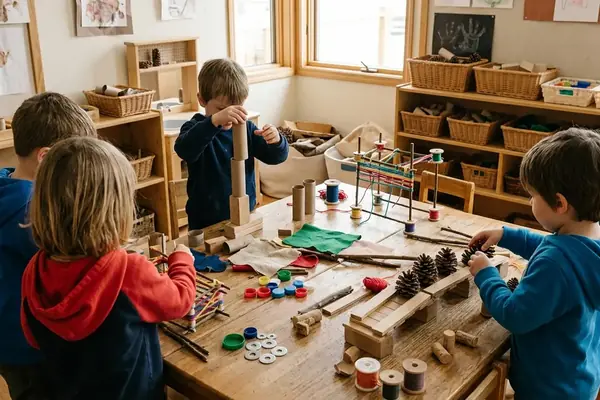
Parallel play asks for something different, and here the choice runs against intuition. When deciding between one elaborate playset and a second copy of a basic set, the duplicate wins. Two identical piles of 15 to 20 blocks, or two matching four-compartment sorting trays placed side by side, let children mirror one another's physical actions. Parallel play depends on that mirroring. A single feature-rich set forces negotiation over access, which is a skill the children have not yet reached for.
Comparing the Social Demand
- Solitary materials require no audience and no partner. They reward a private action carried through to its end.
- Parallel materials require a neighbor and a matching material. No joint goal is needed, only the chance to copy.
A useful boundary belongs here. A child who builds shared bridges with friends one afternoon may still choose a six-piece nesting stack alone the next morning. Solitary play remains an active preference throughout childhood, and a well-stocked playroom keeps room for it.
From a Shared Bin to a Shared Plan
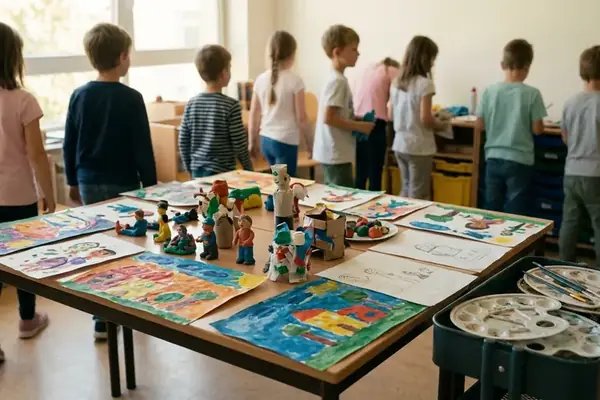
Associative play looks busier than parallel play, yet each child still pursues a separate idea. What changes is the traffic in materials. A central pool of 60 to 80 wooden blocks, a dress-up bin with 6 to 8 loose capes and hats, or art supplies on a common tray all permit borrowing. The quantity matters: the pool must be large enough that one child's borrowing does not empty a neighbor's supply.
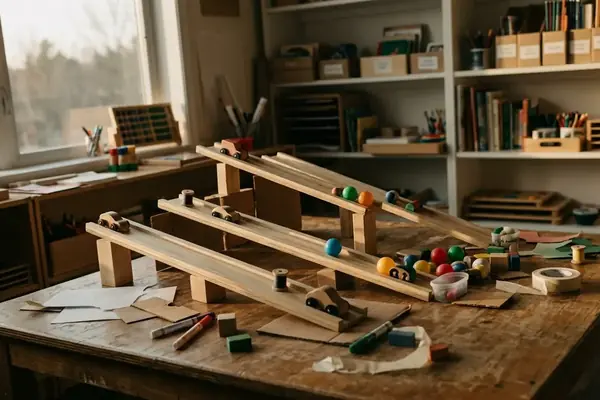
Cooperative play needs a prop that stalls without a shared plan. Pieces that interlock into one bridge qualify. So does a short board game of 5 to 8 minutes with alternating turns, or a cardboard puppet stage built for two or three children, where the roles only make sense together.
One Question That Separates the Two
Can a child walk away from the table with a finished result of their own? If so, the play is associative. If the play collapses the moment one participant leaves, it is cooperative, and the materials should reflect that.
Joint-Goal Toys Come Second
An interlocking bridge set or a multi-role game will not create cooperation on its own. Given to children still playing in parallel, it tends to sit unused or dissolve into disputes over individual pieces. Wait until trading parts and proposing ideas are already happening.
How to Set the Floor, and When to Sit Down Beside It
A parent or educator can arrange this floor within a week, in four steps:
- Give each child a personal pile within easy reach.
- Place one shared supply bin 2 to 3 feet from those piles, a step away from every child.
- Keep sightlines open, so a child can watch others without having to join.
- Allow about a 3-by-3-foot clear zone per child, so turning or reaching does not end in an accidental collision.
Two Sets, One Bin
Two identical open-ended sets within arm's reach, plus one shared bin, is enough for an afternoon. Resist adding a new toy category on the same day; the children need time to discover what the current floor allows.
Adult involvement works best as a short scaffold. Picture a child hovering near two builders, plainly wanting in and unsure how. The adult sits at the edge of the rug, hands over a single block or narrates one turn, and then steps back. The whole prompt lasts somewhere between 30 and 90 seconds. Continuous direction defeats the purpose, because the plot belongs to the children.
Three Play Corners and What Each One Asked of the Children
The following setups come from ordinary play-corner practice, adjusted over a 3-to-6-week cycle of regular sessions. They illustrate fit; they do not describe a named program or a controlled study, and they set no timetable that every child must meet.
The Nesting-Cup Corner
For a child who preferred to play alone, a basket of nesting cups asked for one thing: finish a private action. The child stacked, toppled, and restacked without needing anyone. The corner succeeded because it expected nothing social.
The Doubled Train Track
Two children who built beside each other and glanced across had first been given one shared train set. Tug-of-war over the lone engine followed within minutes. The fix replaced it with two identical 12-piece wooden figure-eight loops and two matching engines. Now the materials asked the children to copy a neighbor, and the disputes faded. The engine had demanded negotiation before the children were exchanging anything at all.
The Puppet Basket and Low Stage
Four hand puppets and a roughly 24-inch-wide tabletop stage were held back deliberately. Offered earlier, a stage like this tends to be ignored. It came out only once the children began handing figures back and forth on their own and proposing who would play whom. At that point the materials asked them to hold a role, and they were ready to.
Buy for the Play You Can Already See
The buying rule here is direct. Purchase for the pattern visible this month, whether that is playing alone, beside, swapping, or planning together. When in doubt, buy a duplicate of a simple open-ended material instead of a role-based or joint-goal toy chosen in hope.
Keep a baseline of two matching open-ended sets on the floor before introducing a single shared-plan prop. Then look again in 4 to 8 weeks, instead of stocking every stage in one shopping trip.
Add the puppet stage, the interlocking bridge, or the turn-taking game only after the children are already trading pieces and telling each other what to build. Buy the second set of blocks first. It is the most reliable purchase in developmental play.