The Block That Stopped Short of the Dollhouse Landing
At a kitchen table, a child between 6 and 9 years old reaches into the upper floor of an open dollhouse to set down a small wooden block. A shirt sleeve catches the miniature doorway. The upper floor tips, furniture scatters, and the block stops short of the landing. Across the table, an adult sets down a flattened sheet of cereal-box cardboard, a single empty thread spool, and a 45-to-60-centimeter length of string.
Moving the lifting action outside the structure avoids the need to reach inside. By building an external cardboard shaft where turning the thread spool raises a lightweight car to the upper floor, the child delivers cargo by rotating a handle rather than reaching a hand into the cramped interior. This shift turns a frustrating fine-motor collision into an exercise in constructive play and mechanical observation.
Successful tabletop engineering at this age depends on a clear division of labor between the builders. The adult manages the sharp tools, structural slotting, and high-tension joints that keep the frame square. Meanwhile, the child takes ownership of the experimental mechanics: marking layout lines, winding the hoist line, running sequential load trials, and watching the platform for any sign of tilt as it climbs.
Cardboard, Spool, String, and a Platform Light Enough to Rise
Gathering materials from the household recycling bin requires sorting paperboard by its structural stiffness. Every piece of the elevator serves either to resist tension or to minimize dead weight on the line. The mechanism relies on five basic components:
- Outer shaft frame: Corrugated shipping cardboard cut into tall vertical wall panels.
- Winch drum: A single empty thread spool measuring roughly 2.5 to 3 centimeters in diameter, mounted on a standard wooden pencil or dowel axle.
- Hoist line: A 45-to-60-centimeter length of cotton string, plus short lengths for the suspension bridle.
- Elevator car: Single-ply paperboard from an empty cereal box, folded into an open-front platform.
- Hand crank: An L-shaped handle cut from stiff cardboard and taped to the protruding end of the pencil axle.
Material selection directly dictates whether the vertical frame holds its shape during play. Corrugated shipping panels require a 3-to-4-millimeter thickness to support the overhead axle without tearing or bowing inward when the string comes under tension. Conversely, building the moving elevator car from thick corrugated board adds unnecessary mass that fights the child's hand on every turn. Using single-ply cereal-box paperboard for the car keeps the suspended platform light enough to rise smoothly while the rigid outer carton keeps the shaft square.
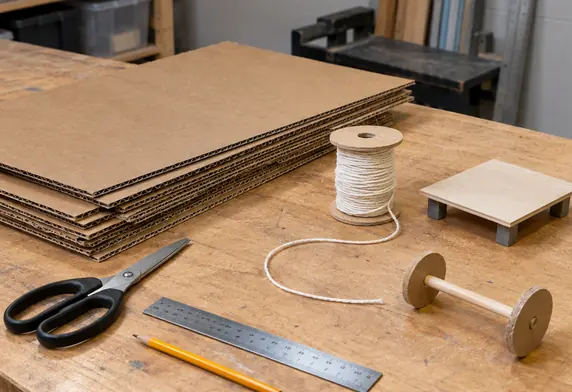
Preparing and taping the raw panels can take 10 to 15 minutes before axle assembly begins. During this stage, the safety boundary remains strict. The adult performs all heavy cutting with a craft knife or strong utility scissors, specifically piercing the matched axle holes at the top of the corrugated walls and slicing clean access slots for the landings. The child handles the layout and preparation: holding the straightedge, marking fold lines in pencil, pressing tape along the vertical wall seams, and pre-winding the cotton string onto the spool.
How Turning the Spool Winds a Pull Into a Lift
A tabletop winch operates as a rotational converter. The empty thread spool sits fixed around its pencil axle at the top of the shaft. As the axle rotates, the drum surface wraps the cotton string around its core, shortening the free length hanging down the shaft and pulling the attached platform upward.
Turning the crank makes the direction of travel visible. Turning the crank handle in the winding direction gathers string onto the spool and raises the car toward the dollhouse landing. Reversing the crank pays the string back out; gravity pulls the lightweight cereal-box platform downward under its own weight, kept steady by the child's hand resisting the unwind.
Mechanical advantage at the kitchen table comes down to grip geometry and turning radius. Pinching and twisting the bare pencil axle directly can fatigue small fingers, so an L-shaped cardboard handle taped to the protruding end of the pencil increases the turning radius, helping the child wind the string smoothly. A thread spool roughly 2.5 to 3 centimeters in diameter takes roughly 4 to 6 full rotations to lift the car 30 centimeters. Extending the crank arm by 5 to 7 centimeters gives a child enough leverage to hold the car steady mid-shaft. Heavier cargo inside the car increases downward tension on the string, which translates immediately into stronger backward pull against the child's fingers on the crank handle.
Raising the Shaft, Seating the Spool, and Hanging the Car
Sequencing the assembly in the order a pair works at the table prevents the common frustration of trapping the elevator car inside a crooked frame. Rather than attaching the string through a single hole punched in the center of the flat car roof—an approach that allows the platform to spin freely in mid-air—this build uses an overhead four-corner bridle to lock the floor level.
- Square the vertical shaft: Tape three corrugated wall panels together to form a U-shaped vertical channel, leaving the front face open so the child can load the car and observe the climb.
- Size and fold the car: Fold the cereal-box paperboard into a three-sided platform with a roof flap. Leave a 2-to-3-millimeter clearance gap between the cereal-box car and the inner corrugated shaft walls so the platform never binds against the frame.
- Seat the axle and drum: Have the adult pierce matched holes near the top edge of the opposing side walls. Slide the wooden pencil through one wall, slip the thread spool onto the pencil inside the shaft, and pass the pencil out through the opposite hole. Wrap masking tape tightly where the spool meets the pencil so the drum cannot spin free of the axle.
- Attach the crank handle: Tape the L-shaped cardboard arm onto the protruding end of the pencil outside the shaft wall, ensuring the 5-to-7-centimeter extension clears the side of the carton as it sweeps in a circle.
- Rig the four-corner bridle: Tie four equal strings to the top four corners of the cereal-box car and knot them together just over 5 centimeters above the roof. Tie the main 45-to-60-centimeter hoist string to that central bridle knot, then lead the line straight up and over the center of the thread spool so winding lifts vertically rather than dragging the car into a side wall.
- Install internal guides: Paste narrow vertical cardstock guide strips along the inside of the shaft walls to act as rails, keeping the car aligned from bottom to top.
Dry-test the empty car with 3 to 5 full crank turns after each structural joint is taped. Watching the empty box travel up and down reveals pinched corners or crooked wall joints while the tape can still be peeled back and repositioned.
A Cork, a Paper Parcel, and a Wooden Block on the Same Car
Jumping straight from an empty dry test to the heavy wooden block that caused the original dollhouse collision hides how the mechanism responds to gradual stress. Staging a four-step cargo progression lets the child feel how crank resistance changes with different play materials before the axle ever stalls.
During each run, the child turns the handle until the platform reaches the upper landing, then holds the crank stationary for 3 to 5 seconds at the top to check whether the spool slips on the pencil axle or the frame flexes. The pair records only what can be seen in the shaft and felt at the handle:
- Run 1 — The empty cereal-box car: The platform establishes the baseline travel path. The child notes whether the four-corner bridle keeps the floor flat across all 4 to 6 rotations and listens for any paper-on-cardboard scraping along the 2-to-3-millimeter wall gap.
- Run 2, A wine cork or cotton ball: Adding a minimal volumetric load tests whether a rolling or shifting object disturbs the balance without taxing the child's fingers. The crank effort feels nearly identical to the empty run, allowing the child to focus entirely on keeping the winding speed steady during the 3-to-5-second hold at the top.
- Run 3, A folded paper parcel: A dense packet of folded construction paper introduces noticeable tension on the cotton string. The child feels the 5-to-7-centimeter crank arm pull backward against the fingers if the hand relaxes, demonstrating how the spool converts downward cargo pull into rotational resistance.
- Run 4, The small wooden block: The original dollhouse cargo places real structural demand on the cereal-box floor and the overhead pencil axle. The pair watches closely as the car leaves the table surface: either the platform rises cleanly to the second-story landing, the car leans until a corner catches on the cutout, or the crank stalls when the child's hand can no longer overcome the backward pull.
When the Car Leans, Stalls, or Scrapes the Shaft
When a loaded run fails to reach the upper landing, separating the visual symptoms prevents the pair from tearing apart a working frame. A lean, a scrape, and a stall each point to a distinct mechanical cause.
Bridle Knot Centering
Stop the lift immediately if the platform floor tilts more than roughly 10 to 15 degrees off horizontal. Continuing to crank a tilted car wedges the cereal-box roof into the corrugated wall and pulls the overhead axle out of alignment.
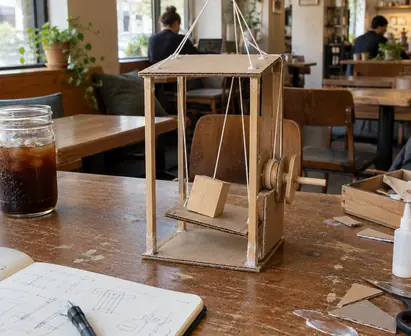
A tilting platform almost always stems from an off-center pull above the roof or an uneven load on the floor. When the wooden block causes the rising floor to dip toward one corner, check the cargo position first, then inspect the overhead four-corner bridle. Shifting the suspension knot by 2 to 4 millimeters toward the dipping corner redistributes the string tension and corrects an off-center platform hang. If the car still drifts sideways as it climbs, paste an extra layer of vertical cardstock onto the internal guide strips to tighten the channel.
Once a jam happens, the child can execute the mechanical reset independently. Empty the cargo from the car, slide the bridle knot a couple of millimeters toward the low side, and perform 1 slow test turn of the crank to confirm the empty floor hangs level before placing the toy back inside. Resetting a jammed car and re-centering the load can take 1 to 2 minutes before resuming play.
Separating a scrape from a true stall keeps the cardboard shaft intact. A scrape means the car is no longer square in the shaft, rubbing its cereal-box edges against the 2-to-3-millimeter clearance gap. A stall means the downward pull of the cargo exceeds what the child's hand and the cardboard handle can comfortably turn. Heavy cargo can tear the unlubricated cardboard axle holes if the child pushes downward on the crank handle rather than rotating it smoothly. When a heavy object stalls the crank, lighten the load rather than forcing the handle.
Which Object Gets the First Real Ride
With the test runs complete and the guide strips set, the adult steps back from the table. The elevator now belongs to the child's imaginative play routine, moving miniature supplies, notes, or figures up to the dollhouse landing without a sleeve ever entering the rooms.
Handing over operational control means letting the child serve as both hoist operator and safety inspector on every new piece of cargo. Which object will you set on the platform for the first full crank, and what lean or stall will make you stop and reset the string before you try again?