The Tuesday Afternoon Ward on the Living Room Rug
Open on a Tuesday living room. A four-year-old has maintained a stuffed-animal hospital across the rug for the better part of three or four days of continuous play. Blankets serve as beds for various patients. A single wooden ambulance sits parked at the edge of the rug, waiting for the next emergency call. A parent stands in the doorway holding an empty storage bin. They weigh whether packing the animals away would make tomorrow's play fresher.
Stay inside that room and that unfinished game. The impulse to clear the floor competes with the ongoing narrative unfolding on the rug. The child has established a complex world requiring specific learning resources to remain exactly where they were left. Packing the scene away disrupts the flow of imaginative play. The hospital requires its staff and patients to remain in position.
Three or four days of continuous play builds deep narrative focus — practitioner accounts of imaginative play indicate as much. Each afternoon the child returns to the scene with new scenarios. The wooden ambulance moves from the edge of the rug to the center of the blankets. Blankets themselves shift to accommodate new patients. Sustained engagement of this kind relies entirely on the physical environment remaining undisturbed. In the doorway, the parent faces a choice between a pristine floor and an active, evolving project.
The Mechanics of Household Inventory Management
Families frequently implement swap cycles of roughly two to three weeks to manage their learning resources. They limit visible toys to a subset of around eight to twelve items on a low shelf. Most toys live in closets or under-bed bins. Parents cite specific motives for this system. A smaller floor demands easier cleanup. Caregivers hope a newly presented bin will restart interest.
This practice functions as a household system. It organizes physical space. Distinguishing between a multi-day stuffed-animal hospital project and a ten-minute dumping session helps clarify the goal of these systems. Confining rigid two-week bin swaps to household storage management provides a clearer perspective on their utility. Cognitive developmental milestones develop independently of these calendar-based schedules.
The aesthetic appeal of a curated low shelf often drives the adoption of these cycles. Caregivers curate those eight to twelve items to create an inviting display. Out of sight, the closets and under-bed bins tell a different story of volume management. For the parent, the motivation centers on easier cleanup and the illusion of novelty. How the child interacts with the smaller subset depends heavily on the specific selection provided.
Clearing the Path in Confined Play Spaces
Consider a play corner so crowded that a toddler cannot reach a requested puzzle without knocking over a tower. Situations arise where a smaller visible set genuinely helps. Play areas of roughly 40 square feet or less require careful volume management. Post-birthday influxes of five to eight new items easily bury everyday favorites. Very young children often dump every available bin when overwhelmed by visual stimuli.
Recognizing Spatial Limitations
Clutter reduction solves a space and attention problem. A curated shelf provides physical access without inherently accelerating brain development. It allows the child to engage with specific learning resources without navigating an obstacle course. Quality of developmental play is shaped directly by the physical environment. A smaller visible set provides a guaranteed path to the requested puzzle.
The mechanics of dumping bins relate directly to spatial overload. When a small play corner contains too many options, the child interacts with the volume rather than the individual items. A post-birthday influx of new items makes this worse. Everyday favorites become lost in the visual noise. Managing the volume restores the child's ability to focus on specific tasks.
Preserving the Architecture of Sustained Projects
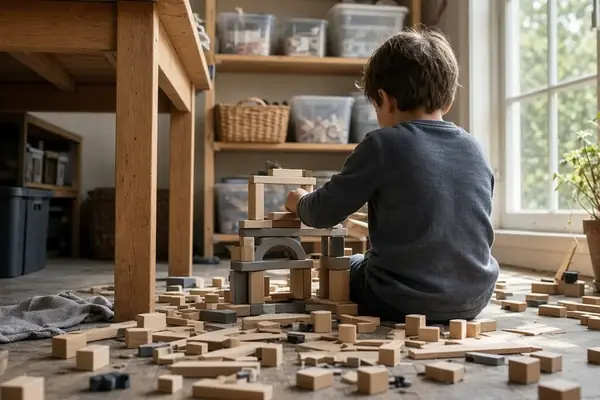
A block city with roads taped on cardboard grows each afternoon. Initially, caregivers frequently box up a sprawling block city every night to maintain a clean floor. Observation reveals a clear pattern. The child abandons the rebuilt structure within about ten or fifteen minutes the following day. Caregivers discard the daily reset rule. They shift to leaving the core foundation intact while only clearing the perimeter.
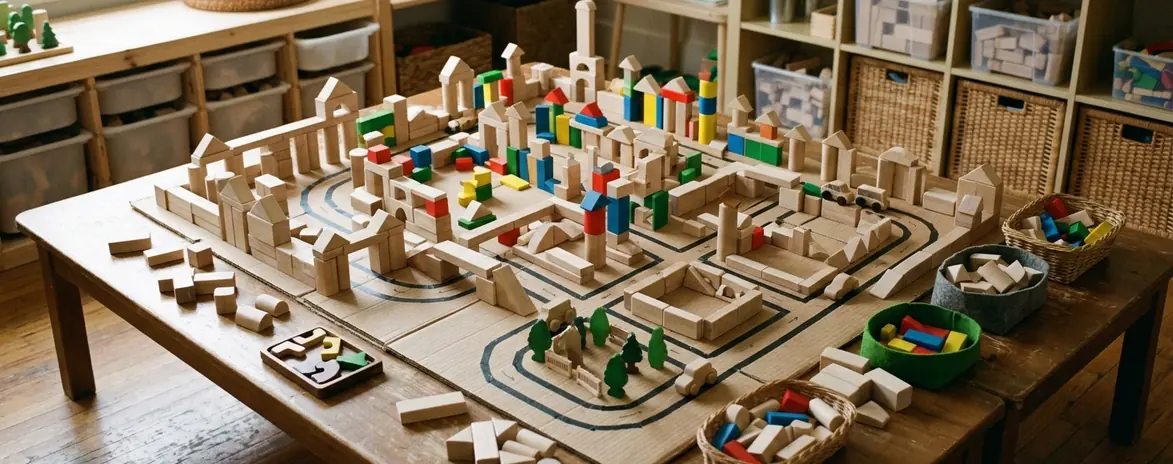
Sustained interests suffer when materials vanish. Pretend families, marble runs, train layouts, and art left to dry beside the same crayons require continuity. Unrestricted access ensures the working set stays findable. Caregivers can still remove broken or ignored items.
Prioritizing Project Continuity
Constructive play relies on the ability to return to a project and build upon previous work. That brief stretch of play before abandonment highlights the frustration of starting over. Leaving the core foundation intact respects the child's effort. The taped roads on cardboard represent a significant investment of time and planning. Erasing that plan overnight discourages future complex projects.
Continuity matters well beyond block cities. Marble runs require precise alignment that takes hours to achieve. Train layouts expand over days as new routes are imagined. Creative arts projects often involve multiple stages of drying and layering. These activities demand a physical environment that supports long-term engagement.
Evaluating Floor Activity Before Implementing Systems
Take a three-to-five-day observation window before writing any bin schedule. Photograph the floor at the end of play for three days running. Look for signs the current set is working. Children return to the same materials. They add a new role or structure. They resist cleanup because the scene remains unfinished.
Optimizing the Observation Window
Identify signs the floor is only noise. Brief dumping occurs. No return to a piece happens. Frustration arises at not finding a needed object. Identifying the optimal time to intervene requires patience. The photographs provide an objective record of the play patterns. Analyzing the photos reveals whether the mess represents productive engagement or unproductive noise.
These checks function as household observations for evaluating daily engagement. They operate separately from clinical screens. They do not replace advice from the child's own pediatrician or teacher when play itself seems stuck or distressed. The goal involves understanding the child's current interaction with their environment. A few days of watching offers enough to make informed decisions about space management.
Adopting a Flexible Approach to Shelf Management
Offer a flexible alternative to the rigid calendar. Keep the active project out. Retire only the ignored extras. Bring a stored toy back when the child asks for it by name. Compare a fixed Sunday swap with a rule that follows the child's plot. Limit the visible overflow to one or two closed boxes. Exempt three or four core items like comfort objects and book piles.
A single open shelf of working toys plus one closed overflow box provides a manageable environment. It supports ongoing creative arts projects while minimizing visual clutter. This approach respects the child's current interests. The "when the hospital closes" rule allows the narrative to reach its natural conclusion. A fixed Sunday swap interrupts the plot arbitrarily.
Keeping the visible overflow to one or two closed boxes maintains order without imposing rigid schedules. Exempting those few core items ensures essential comfort objects remain accessible. This flexible approach adapts to the child's changing needs. It prioritizes engagement over calendar-based organization.
The Enduring Design of Classic Building Materials
Many classic playthings were made to be left out and returned to. The material assumes continuity. Let that design choice reframe the bin in the parent's hands. A rigid rotation calendar serves as a storage preference. Developmental requirements rely on continuity rather than scheduled disappearances.
The physical properties of constructive play materials dictate their use. A tower started on Monday requires the same pieces on Friday to reach completion. The design of these materials encourages long-term, sustained engagement. They invite the child to build, leave, and return. Caroline Pratt designed her unit blocks in 1913 around standardized proportions, so a piece cut a century ago still meets a piece bought today — and still meets the piece a child left on the rug last Tuesday.