How Kit Instructions Taught Adults to Correct Odd Towers
Numbered construction kits changed more than the way children assembled toys. They also trained adults to expect a recognizable endpoint: every piece accounted for, every joint aligned, and the finished model matching the photograph on the box.
I began tracing this habit during the late 2018 holiday season while observing families in independent toy retail spaces. During observation periods of somewhere around 45 to 60 minutes, adults repeatedly guided children away from loose block bins and toward boxed sets with 20- to 30-page instruction booklets. The children often lingered over the loose pieces. The adults favored the certainty of a defined project.
That purchasing pattern followed families home. It also entered classroom block corners, where a crooked wall could draw an adult hand before the child had decided what the wall was meant to do. Adults preempted collapse, restacked pieces in a stable orientation, and praised close copies of displayed models.
These observations were limited to particular retail periods and settings, so they do not describe every family’s play habits. They do reveal a useful mechanism. When adults spend enough time around single-model kits, deviation begins to resemble assembly error. A roof placed three pieces to the left looks unfinished rather than experimental.
Instruction-Sheet Drift
Before adjusting a child’s structure, ask whether the piece violates a safety boundary or merely departs from the picture you expected.
The Afternoon I Stopped Reaching Into the Block Pile
The build that changed my response was a leaning bridge made from 14 standard unit blocks, give or take. Its left pillar tilted inward. The roof sat roughly 3 to 4 inches left of the load-bearing support, where it seemed to have no structural right to remain.
My hand was already preparing the correction. I wanted to rotate one block by 90 degrees, square the joint, and preserve the span. The intervention would have taken a second.
Past corrections had produced a consistent practical problem: the child often abandoned the build within minutes. Once an adult supplied the decisive move, the remaining work no longer felt fully owned. So I sat on my hands. That physical choice mattered because it removed the possibility of an automatic rescue while I decided what to say.
The bridge held briefly. The child added another block, watched the left pillar shift, and leaned close without touching it. Then the span came down across the rug.
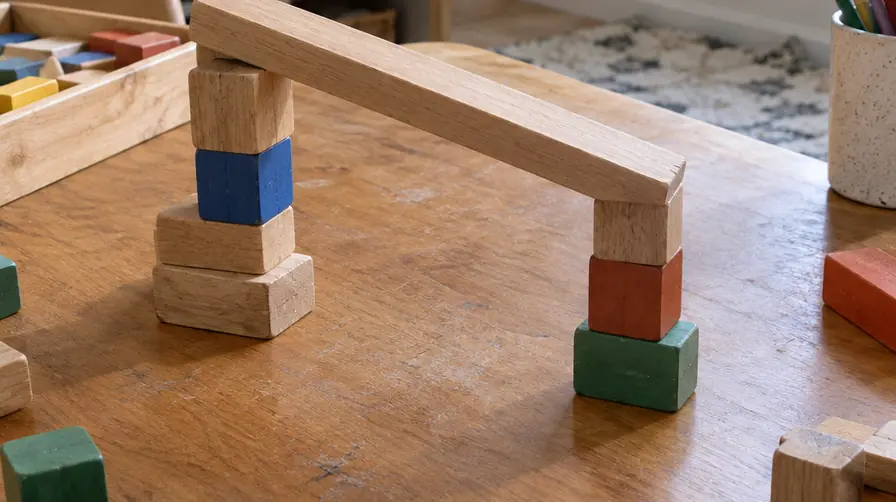
Silence left the next move with the child. That was the turning point.
What the Collapsed Bridge Made Visible
A warning such as “that will fall” gives a child the adult’s conclusion. Collapse supplies physical information. The location of the scattered blocks, the direction of the fallen span, and the one pillar still standing all become evidence that can be handled.
The child studied the pieces and began again without prompting. Initially, the foundation measured about 6 inches. The rebuilt foundation was twice as wide. A counterweight appeared on one side as the span was doubled. It looked awkward to an adult eye and worked under the load.
The rebuild took between 8 and 12 minutes, more or less. That duration matters less as a performance measure than as evidence of sustained inquiry: the child remained with the structural problem long enough to test a new arrangement.
Productive Failure Has a Visible Cause
I classify a collapse as productive when the child can inspect what happened and attempt another configuration. Shame changes the task. Once an adult labels the build “wrong,” attention shifts from balance and force toward pleasing the observer.
The play surface also affects what the child can learn. On a low-pile rug, fallen blocks tend to remain near the failed joint. Hardwood or tile can send them scattering too violently to preserve that visual trail. In that setting, moving the constructive play to a rug may protect both the materials and the child’s ability to reconstruct the sequence.
Keep the Evidence
Pause before clearing a fallen build. The scattered pieces may show the builder exactly where the load shifted—information that disappears when an adult immediately tidies the pile.
The Questions I Use Before Offering a Fix
Adult warnings often arrive during the most demanding part of construction: the child is reaching, aligning a piece, and estimating pressure at the same time. Speaking mid-reach interrupts that motor planning. Even a helpful sentence can displace the child’s next action.
I now wait for a natural pause of something like 3 to 5 seconds. Then I use a question that returns attention to the structure:
- Where does it feel wobbly?
- What happens when you press here?
- Which part is carrying the long piece?
- What could you try underneath it?
Each question points toward observation without prescribing orientation. The child still decides whether to widen, rotate, remove, or continue.
When more material would help, I place 1 or 2 spare blocks nearby. I do not turn them or indicate a destination. Offering material preserves the problem; placing the “correct” block completes part of the reasoning on the child’s behalf.
A Short Intervention Sequence
- Stop your hand before it enters the build.
- Watch the child’s eyes and hands for a genuine pause.
- Ask one question about movement, balance, or support.
- Wait through the next attempt.
- Offer loose material only when the child appears to need another option.
This sequence feels slow at first. In practice, it often takes less time than repairing a structure the child no longer wants to claim.
Building Sets That Leave Room for Structural Experiments
The design of a building set influences how readily adults tolerate unusual results. Open unit blocks, plain wooden planks, and magnetic tiles offer simple relationships: stack, bridge, enclose, lean, and counterbalance. A piece can move from a road to a roof without becoming misplaced.
Snap-together kits create a different play condition when specialized parts have one obvious destination. Leftover pieces can announce apparent failure, especially when the box displays a single official model. A decorative component that fits only one connection narrows the child’s choices before play begins.
Playroom audits sharpened my selection criteria. Sets containing 40 to 60 identical wooden planks returned to use daily. Specialized snap-together kits were often left aside after 2 to 3 days of initial assembly. The contrast came from the kinds of questions each material could hold. Repeated planks supported fresh problems; single-purpose pieces tended to preserve one answer.
What to Look for in the Bin
- Simple geometry: rectangles, squares, arches, and triangles that work in several orientations.
- Mixed scales: pieces large enough for foundations and smaller pieces suited to adjustment.
- Off-grid stability: surfaces that can overlap, lean, or bridge without a dedicated connector.
- Few single-purpose accessories: no central “hero” piece that dictates the identity of every build.
- Durable repetition: enough similar pieces to test width, height, symmetry, and counterweight.
A useful set supports constructive play one day and imaginative play the next. The same planks may become a bridge, an animal enclosure, or shelves in a small shop. Creative arts materials can join the scene without forcing the structure toward a box image.
Where Wobbly Play Ends and Physical Risk Begins
Withheld correction has a firm safety boundary. Dense maple blocks can weigh between 4 and 6 ounces each. A tall structure made from them carries consequences beyond a disappointing collapse.
I assess scale and setting before judging the architecture. Any structure exceeding the child’s shoulder height requires an adult spotter. For many young builders using these materials, that concern emerges around 36 to 40 inches. Builds near a toddler, staircase, glass surface, or exposed eyes require immediate relocation or reduction.
The safest intervention often changes the environment while preserving the design.
- Move the work from a high table to the floor.
- Place dense blocks on a low-pile rug.
- Clear younger children from the likely fall zone.
- Stand close enough to intercept heavy pieces from above.
- Leave unconventional joints alone when the scale and setting are safe.
Move the Build
When height or location creates the danger, change the workspace. Rebuilding the child’s unusual joint may make the structure tidier while leaving the underlying hazard in place.
This distinction keeps developmental play intellectually open and physically contained. Adults remain responsible for bodies, eyes, heavy materials, and fall zones. Children can retain responsibility for the architecture.
Sunday Light on an Arch That Should Not Have Held
One Sunday morning, six maple blocks and two magnetic tiles stretched across a 10-inch picture book on the play-table. The arch leaned toward the window. One tile carried an edge that seemed too narrow, while a block at the opposite side served as an improbable counterweight.
The child pressed the crown with one finger, released it, and waited. Sunlight moved across the book cover. The arch stayed.
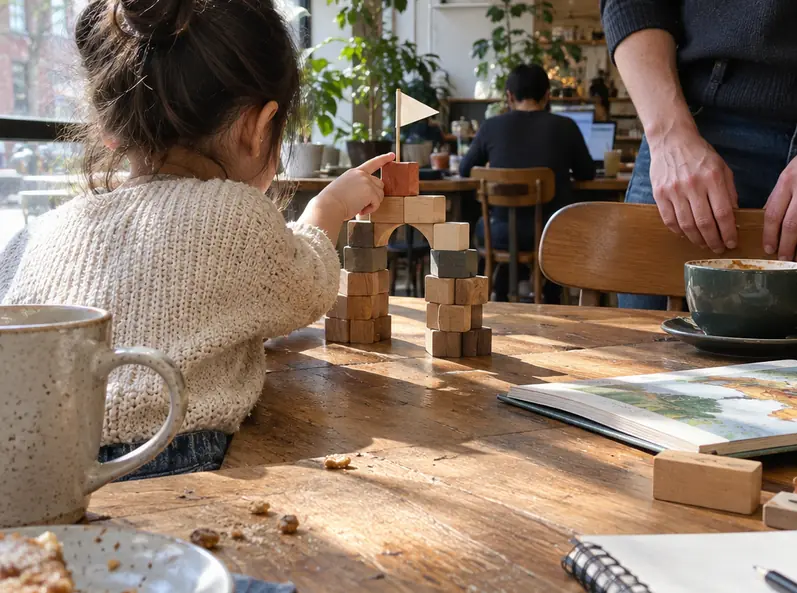
A grin arrived before any words did. Then the child lifted a small flag and set it on the highest block, exactly where an earlier version of me would have reached in to protect the span. My hands remained beside my chair. The flag trembled once, and the odd little arch continued standing in the Sunday light.