The Cost of a Static Incline
A one-height ramp and a single object give motion without a chance to connect the act of releasing an item with its subsequent roll, stop, or acceleration. The child watches the movement happen, yet the environment offers no mechanism to test how their own actions influence that movement. A toddler attention loop for a static, unchanging ramp may last somewhere around 45 to 90 seconds before they abandon the activity. A static ramp can quickly become easy to abandon.
When the setup is sequenced and variable, the child gains a short, repeatable loop they can restart, interrupt, and try again. They learn that their specific physical input directly dictates the behavior of the object. The play shifts from passive observation to active experimentation.
The sequence begins with materials and a first slope, then moves through observational cues, harder runs, motor adaptations, and one copyable afternoon progression.
Assembling a Functional Gravity Kit
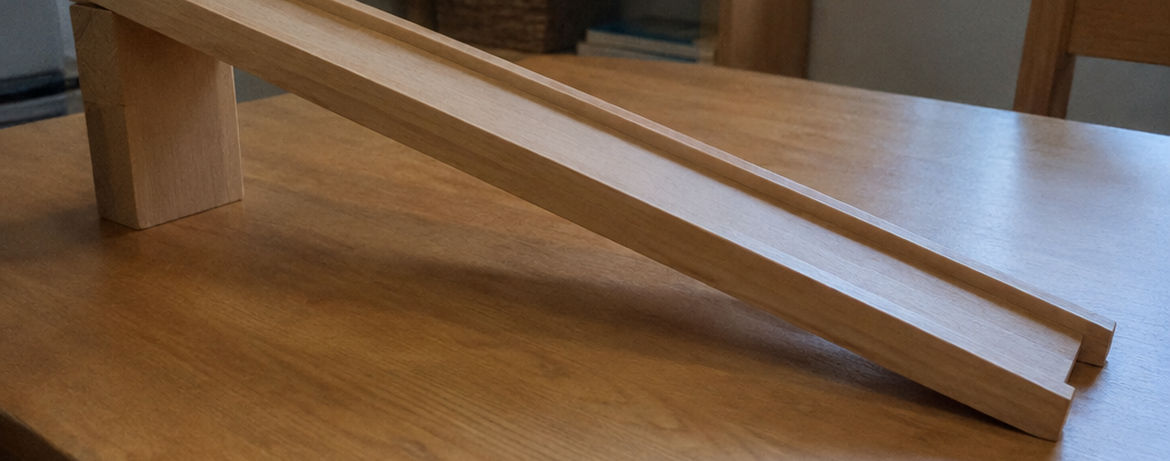
Building a working kit requires specific, intentional materials. A rigid cardboard or wooden board measuring something like 24 to 36 inches long provides enough runway to observe acceleration without taking up the entire room. This length offers a useful runway for early visual tracking. You will also need a low starting prop, such as a single book or a firm sofa cushion.
Gather a diverse set of rolling objects. Select one light ball, one heavier rubber ball, one free-rolling toy car, and a solid wooden block that can sit flat on the slope.
Surface selection dictates the success of the entire activity. A smooth hardwood or tile run allows the object to maintain its kinetic energy long after it leaves the ramp. A thick rug kills momentum immediately before the child can see the result of the descent.
Setup Tip: Surface Friction
Inspect your materials closely before introducing them to the play space. Flag objects that fail the activity entirely. Cars with stuck wheels, balls that wobble off the board, and ramps that sag cause the roll to die halfway down the track. Selecting materials with certified non-toxic finishes ensures the items remain safe during inevitable mouthing and sensory exploration.
Establishing the Baseline Descent
Process the first successful roll with deliberate slowness. Prop the board on a single standard children's board book. This provides a starting elevation of 0.5 to 0.75 inches, give or take, creating a slow, trackable descent. Place the light ball at the top of the incline.
Release the object without a push.
Let it travel the full length of the board. Caregivers often initially try to push the ball down the ramp to make the activity more exciting, but this masks gravity's role. By deliberately choosing to keep hands behind the back immediately after release, the adult ensures the child attributes the motion entirely to the slope rather than human force. Keeping the release gravity-driven rather than adding a push helps the child connect the slope with the motion.
Reset the board in the exact same spot. Maintaining a consistent starting location allows the child to place or knock the ball themselves on the next turn.
Observing the Mechanics of Discovery
Watch for three specific cues in sequential order. First, look for a still gaze as the object starts its descent. Second, watch for a physical reach toward the bottom of the ramp as the object approaches the floor. Third, observe the child's return to the top of the ramp to try the sequence again.
Treat those cues as play evidence. They represent active cognitive processing and spatial anticipation. You can compare these observations in a general way with public toddler checklists, such as the CDC 18-month developmental milestones, which includes simple toy play like pushing a car. Comparing a child's play cues to public developmental checklists applies strictly to general population screening and cannot substitute for a clinical evaluation if motor delays are suspected. The checklist functions as a population screen.
Developmental Takeaway: Emerging Vocabulary
Note the language that often arrives alongside this physical loop. Words like "go," "down," and "uh-oh" emerge naturally as the child vocalizes the action they are witnessing. Allow these words to surface organically. Avoid forcing verbal repetition before the child is ready to connect the sound to the action.
Introducing Variables to the Track
Raise the challenge by altering one variable at a time. Begin by placing a second book under the board. Adding a second book typically raises the incline by an additional 1.5 to 2 inches, more or less, which visibly alters the descent speed without causing the object to launch off the track.
Next, introduce the heavier rubber ball on the original, lower slope. Finally, swap the ball for the toy car.
Compare the outcomes out loud in plain terms. The steeper board is faster. The heavier ball travels farther across the floor. The car may veer off to the side. The block placed directly on the slope makes a sudden stop or a loud crash. These verbal descriptions map language directly onto the physical properties the child is observing.
Observation Warning: Variable Overload
Add a single mid-ramp block only after the child has completed several clean, uninterrupted rolls. Introducing the block changes the reaction. The interruption serves as a new cause, creating a predictable effect rather than visual chaos.
Adapting the Setup for Motor Variations
Lower the start to cushion height for children who are still developing a precise fine-motor release. Applying a 2-inch wide masking tape border or using a shallow cardboard gutter prevents lateral spills. This modification keeps the ball on the track while the child practices their aim.
Offer alternative release methods if an independent pinch-and-let-go is unavailable. A two-hand release works well. A container dump at the top of the ramp allows the child to pour the object onto the slope. A gentle nudge from a wooden stick provides another accessible way to initiate the roll.
Slow the roll with a shallower angle or a carpet runner when tracking a fast object proves difficult. Speed the visual payoff with a bell or a metal cookie sheet placed at the bottom of the ramp when attention is brief. The auditory feedback rewards the child's visual tracking efforts immediately.
A Complete Afternoon Progression
Work through a single copyable case to put these concepts into practice. Clear a long strip of hallway to provide ample floor space for the rollout. Gather your materials: one cardboard ramp, a standard paperback book as the first lift, a ping-pong ball, a heavy rubber ball, a wooden car, and one wooden block. The four-run sequence fits into a short afternoon engagement window before toddler fatigue sets in.
For Run 1, use the paperback height and the ping-pong ball. The caregiver models one silent release, keeping their hands entirely away from the ramp after letting go. The child repeats this action until the ping-pong ball reaches the end of the hallway twice.
Run 2 maintains the exact same paperback height but introduces the rubber ball. The child places the heavier object at the top and releases it independently. Notice the longer roll as the increased mass carries the rubber ball further across the hallway floor.
In Run 3, swap the rubber ball for the wooden car. The child must align the wheels with the downward slope before releasing, adding a layer of spatial orientation to the task. They observe how the fixed axles change the trajectory compared to the spherical balls.
For Run 4, introduce the wooden block halfway down the cardboard ramp. The child releases the car from the top and watches it collide with the block. They reset the block, retrieve the car, and initiate the collision again, fully controlling the sequence of cause and effect.