A vet clinic built from household stuffed animals is one of the few pretend-play setups that improves the longer it stays standing. The patients accumulate histories. The paperwork piles up. A rabbit treated for a limp on Monday returns Thursday for a follow-up, and suddenly a child is practicing continuity of care without anyone naming it as such.
The Four-Minute Collapse of Unstructured Pretend Care
When caregivers hand over a pile of medical props with no fixed place to use them, the pretend care tends to dissolve quickly. Observation in home and early-childhood settings puts the window at roughly four to six minutes before the scene degrades into prop-grabbing: two children tugging at the stethoscope, the stuffed patient abandoned on the floor, the story gone.
The loss is larger than a ruined afternoon. Pretend caregiving is one of the more reliable vehicles for rehearsing comfort-giving behaviour, and a collapsed scene ends the rehearsal before the interesting part begins. Nobody gets to soothe a frightened dog. Nobody explains aftercare to a worried owner.
A standing clinic changes the arithmetic. It gives imaginative play a repeatable address, which in turn supports turn-taking, extended cooperative scenes, and the slow accumulation of a shared story. The setup itself is modest: gathering stuffed animals and basic props already in the house takes somewhere between twelve and eighteen minutes, which means the whole clinic can be operating before the afternoon is half over.
Clinic Readiness Check
Before buying anything, count the stuffed animals already in the house. Three or four of visibly different sizes is a working caseload. A fifth adds sorting time without adding story.
A Small Herd, Five Tools, and Paper That Carries Stories
The instinct to buy an all-inclusive kit deserves scrutiny. One early-childhood approach began with a full fifteen-piece plastic vet set and watched children spend the entire session sorting the tools, categorising them, arranging them by colour, and never once examining an animal. The kit had become the activity.
Swapping it for a curated five-item list returned the focus to the patients almost immediately: a toy stethoscope, gauze, a small box for bandages, a bowl for water, and a clipboard. Five objects, each with an obvious function, none of them requiring instruction.
Patient selection matters as much as prop selection. A herd of three to four stuffed animals with distinctly different sizes gives each visit a different physical problem to solve. The large bear needs two hands and a bigger towel. The tiny mouse fits in a palm and invites gentler handling. Same clinic, different care.
Printable paperwork is the third element, and it works best when nobody grades it. Intake forms, appointment cards, and prescription slips function as story fuel: places to scribble, mark, or draw a diagnosis that only the child can read. The moment a caregiver starts correcting spelling on a prescription slip, the paper stops being a prop and becomes a worksheet.
Three Zones in a Living-Room Corner
The three-zone layout was not designed on paper. It emerged from tracing how two children actually moved during a shared session, and from noticing that the clinic kept getting knocked over when arrival, examination, and treatment happened in the same square foot of carpet.
Separation solves it. Chairs become the waiting room. A towel-covered table or an upturned crate becomes the exam surface. A low shelf becomes the pharmacy. Roughly eighteen to twenty-four inches of walking path between stations is enough for two players to pass each other without a collision, and the walking itself adds narrative time: the trip from waiting room to exam table is when a child decides what the animal is suffering from.
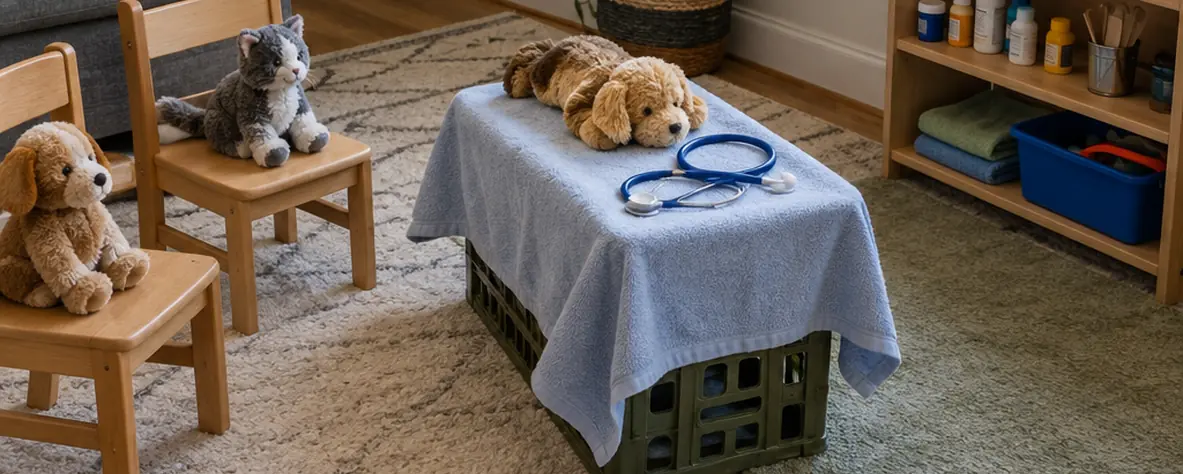
Marking the exam table with tape, a crate, or a cardboard box gives the clinic a boundary children can return to across days. That boundary is what turns a one-off game into a place.
Floor space sets a real limit. A distinct three-zone footprint wants at least four by five feet; tighter homes do better condensing waiting area and pharmacy onto a single tray roughly twelve by eighteen inches, keeping only the exam surface separate. The timings and dimensions described here reflect patterns noted in practice rather than formal measurement, and a child absorbed in a long case will happily ignore every one of them.
Stock the pharmacy with labeled jars, cotton balls, and pretend medicine cups. Counting and matching happen naturally there, and none of it requires reading.
Opening Lines for the Owner, the Vet, and the Front Desk
Three roles keep a clinic running, and each benefits from a first line rather than a script. The worried owner arrives with something like she hasn't eaten since yesterday. The examining vet answers with let's have a listen. The receptionist closes the loop: can you come back Thursday?
Complaints work the same way. Three concrete starting points cover most of what a child needs: a limp, a lost appetite, tangled fur. Each is specific enough to act on and vague enough to invent around. Children supply the middle and the ending, which is the entire point.
The most useful adult behaviour is silence. Pausing in the ballpark of ten to fifteen seconds after the examination hands the child the treatment decision, the medicine's name, and the aftercare explanation. Fill that pause and the caregiver has quietly taken the case.
Jobs for Toddlers, Ledgers for Older Siblings
Mixed-age clinics fail in predictable ways: the toddler wanders off, the eight-year-old becomes an unhappy supervisor. Concrete physical tasks solve the first problem. Children between roughly twenty-four and thirty-six months stay inside the shared story when their job is holding the patient still, fetching gauze, or filling the water bowl. The task carries them; no verbal roleplay required.
Older siblings need authority, not chores. The receptionist ledger works well because it involves writing, sequencing, and control over the schedule. A specialist role does too: the one who handles broken bones, or the only person allowed to write prescriptions.
Reluctant talkers deserve a silent route through the clinic. Pointing to the sore body part, drawing the injury on an intake form, or simply lining patients up in order of urgency are all legitimate ways to participate. Forced narration drives shy players out of pretend play faster than almost anything else.
Costume Kit Versus Standing Clinic: What Each Sustains
A bought doctor kit used as a costume produces a recognisable pattern: the child dresses up, examines one animal, and the game ends. A clinic with stations, forms, and returning patients produces something structurally different.
Tracking play across several days showed the introduction of intake forms correlating with children reusing the same stuffed animals for ongoing care — caregiver accounts of repeat visits report as much. What the open clinic adds:
- Play cycles extending from a single fifteen-minute session into recurring forty-five to sixty-minute blocks
- Shared roles that let two or three children occupy the scene at once
- Reasons to bring the same patients back across three or four consecutive days
- Written traces that let a story resume instead of restarting
None of which condemns the simple kit. For a child playing alone for hovering around twenty minutes, or for a household with no spare floor, the costume version is entirely sufficient. Stations and charts earn their keep when more than one child is playing, or when the aim is play that survives overnight.
The Tell: When a Child Stops Inventing Complaints
Overbuilding is the common failure of enthusiastic setups. A dozen tools, adult-written diagnoses, corrections to the pretend medicine's dosage, and the child gradually stops leading.
The diagnostic sign is easy to read. A child who waits for instructions instead of announcing the next patient's problem has handed the clinic back to the adult.
Resetting the Caseload
Remove half the props. Cut the medical tools from a dozen down to three or four core items, keep the three stations intact, and say nothing about what the next patient has. The following visit belongs to the child.
Which Patient Checks In First?
The whole clinic does not need to exist before play begins. One animal, one ailment, one station is a complete first ten-minute block, and the waiting room can appear tomorrow.
So before the next play hour: which stuffed patient is coming in, and what is wrong with it?